Monday, May 26, 2025
Intelligence - Artificial Intelligence (AI) versus Human Intelligence
AI, AI, AI! It's the "new thing out there," and we now see its incorporation into not only on the internet, in business, but - in increasing degrees - into education as well. As a math graduate, it is worthwhile to consider whether this tool is one to be embraced or regarded with concern. A simple experiment might shed light on the matter. Having recently done a cursory search on comparing heat pumps to the more traditional air conditioning units, the "all-knowing" AI provides the following analysis: "....A heat pump can achieve efficiencies of 300-400%, meaning it can produce three to four times more energy in heating than it consumes...." My goodness! We have defied the laws of physics! We have just created energy out of nothingness, violated Conservation of Energy. There is a term for this- "Magic!" This experiment would seem to indicate that extreme caution - at a minimum - is needed in incorporation of AI, unless we are willing to be risk be lead astray (as per the above experiment).. It seems that - at most - using AI sparingly to assist with tedious internet searches or self-tutoring or comparable tasks would be advisable. To make major decisions, including developing complex math modeling, it would seem to be highly advisable to ensure that human intelligence remain the primary tool utilized, with delegation of "mindless" or "near mindless" tasks to AI.

2025 SIAM Mega Math Challenge problem - staying cool as the world heats up
This year in particular - in light of recent ongoing national and international
crises -my curiosity concerning SIAM's choice of challenge problem was
particularly acute. (Our team at CAVA competed this year as well). Rather than finance-based math modeling as we
have seen in the majority of recent years, this year's problem focused on
engineering-based math applications, incorporating the effects of climate change
and increasing incidence of life-threatening heat waves. Insofar as climate change is considered (as per the Bulletin of Atomic Scientists) our the 2nd greatest existential threat to our species, directing minds of our mathematically-inclinded gifted youth to addressing this threat would seem a very worthwhile endeavor.
There are some points I might note by way of commentary. When asked to model temperature as a function of time, the model which - to my mind - seems most obvious and practical is that of a sinusoidal function, a particular instance of the wave function. As such, one need only obtain the parameters (A, B, C, D) of the equation y = A sin [B(x - C)] + D, or, equivalently, y = A cos [B(x - C)] + D, with value of C being the only significant difference between the two. A = the amplitude, or 1/2 (max - min), B = 2 PI / period (where period = 1 day, or 24 hours), C = horizontal shift relative to the beginning of the period, and D = midpoint for y (temperature), equal to max - min. That would seem to suffice for modeling outdoor temperature based on present data. Modeling of rising temperatures over the 20-year time as the challenge demanded (2025-2045) could be modeled using the relatively simple and pessimistic scenario of linear growth, or the more complicated scenario of logistic growth. Lastly, to model indoor temperature - given outdoor temperatures - it seems to my mind to be most practical to make use of prior studies in this area. (The competition rules allow finding other sources which are published and do not involve real-time interaction with humans, inclusive of posts). I notice - upon cursory search on the internet - a 2013 study by Nguyen, Schwartz, and Dockery which concluded that "At warmer outdoor temperatures, there is a strong correlation between indoor and outdoor temperature (Pearson correlation coefficient, r = 0.91, slope, β = 0.41), but at cooler temperatures, the association is weak (r = 0.40, β = 0.04). Results were similar for outdoor apparent temperature...." It seems to me that this is sufficient machinery to proceed with creating a viable mathematical model within a constricted time frame. Upon scrutinizing the winning entries' solutions, I notice that they all seem to have employed integration at a minimum. I might apologize for my naivety, but shall dare to pose the question "Why?" I would understand if one is using integration for the purpose of utilizing a logistic growth curve (optimistically) to incorporate gradual stabilization of climate change over the long-term. However, I noted use of integration coupled with Newton's law of cooling to model temperature change throughout the day. Yes, Newton's law of cooling, and the heat equation generally, do model heat transfer; however, is utilization of such truly needed? Also, many teams seem to have utilized Python, the current programming language of choice. (A few decades prior, C++ was the computer language of choice. This was replaced with Java. Now, it seems, Python is most prominent, and the above enunmerated languages are "medieval." Fortran is "ancient.") There is an analogy I might offer. Suppose you are in attendance at a dinner party as a required social or professional gathering. This dinner is being held at a formal restaurant, serving mostly meats which - owing to dietary restrictions or personal reservations - you are unable to eat. You must order something however, and have contented yourself with ordering a tempting dessert, a chocolate mousse cake with berries on the side. Being a formal restaurant, every place setting includes multiple utensils, including salad and dinner forks, teaspoon, tablespoon, regular knife, bread knife, and dinner knife. Which utensil(s) would you utilize to partake of your dessert? It seems to me that a fork - either fork - perhaps coupled with one of the spoons would suffice. Oh, but that steak knife is especially shiny, with an impressive serrated blade, and seems - in its creation - to display incredible engineering in its construction. You simply MUST use that steak knife! Not only that, but - oh, you have been practicing your fencing the past several months, and surely MUST impress your tablemates by displaying your fencing skills in some way. Perhaps if - while eating your mousse cake and berry salad with your shiny, beautifully engineered steak knife - you can figure out a way to display your fencing prowess at the same time. You proceed to literally attack your mousse cake. "En garde! Defend yourself, Mousse cake!" Hopefully your tablemates will refrain from fleeing in terror. Very well, you have displayed the entirety of your fencing training, but is that truly needed? I presume there will be some to many who will counter that my own suggested model is oversimplistic, and use of calculus and numerical programming are required. I do not dispute this; however, why reinvent the wheel unnecessarily? The study I cited above - which relates indoor to outdoor temperature - seems to have already incorporated this in determining this relationship. The late Isaac Newton himself - who was far from humble - conceded that his own developments in math and the sciences were built upon the achievements of former pioneers in the field. If the relationship is already established by PhD-level mathematicians, why not utilize the results of the research they have already done (especially within the context of a 14-hour competition)? It seems that one could model daily temperature data using a sinusoidal model, scaling the amplitude of the outside temperature by a factor of roughly 0.41 as per the above mentioned study and leaving the other parameters unchanged, and then adjust for the long-term projections of global warming to the extent that the above enumerated temperatures are impacted. The other factor which struck me as puzzling was the minimal emphasis which the top entries seem to have placed on energy efficiency, the advisability of modernizing air conditioning systems and transitioning to Zero Net Energy. I presume transitioning from traditional air conditioning to modern heat pumps, coupled with shifting to (eventually) all-renewable energy sources for electricity generation would largely alleviate the drain on the energy grid as per the challenge prompt. Also, encouraging or requiring homeowners and commercial building owners to install solar panels, preferably with backup generators to provide electricity in the event of power outages, would be beneficial as well. The last set of suggestions would seem to move somewhat off the path of traditional math modeling and enter into the realm of electrical engineering. Even so, it seems that some incorporation of these suggestions, along with "back of the envelope calculations" would improve the accuracy and usability of the model developed.
Sunday, May 12, 2024
2024 MathWorks Math Modeling Challenge - A Tale of Two Crises
It has been my pleasure to once again register our math team at CAVA to participate in the M3 Mega Math Challenge. I am happy to announce that this year - for the first time - our team was successful in triage. Our students are to be commended for this achievement. I must also express my congratulations to those students and teams who advanced further, including those who attained finalist, semi-finalist, and honorable mention prizes. In these trying times, it is especially important that the M3 Math Challenge continue in its mission to involve our top high school students in using math modeling to tackle aspects of our current, pressing crises. I would make the case that our country needs more activities of this nature. I would go further yet and declare that this is a model of how we might pivot and redirect our focus away from the excessive standardized Testing, Testing, Testing, and emphasis on Standards, Standards, Standards, and - instead - challenge our students to tackle problems in a way that their results might be utilized by our
leaders to improve conditions in this country. Climate change, conversion to electric vehicles, and short- and long-term trends in telecommunication are among the topics from recent years. This year, the topic is that of solving the problem of homelessness in major cities. Here you go, young scholars- take the raw data on population and homeless figures, extrapolate a mathematical model encompassing the next 50 years, and give us the Answer to homelessness. Good luck!
Ah - one of the crises facing humanity throughout this planet - homelessness. Though we often think of it as a modern urban issue, we find references to this "problem" dating as far back as the early 17th century Many of us recall having read, as required high school reading, "A Modest Proposal," the satirical essay by Irish author Jonathan Swift, suggesting that utilizing Irish babies as a food source (more bluntly, resorting to cannibalism) would be a logical remedy to poverty in Ireland. This particular essay may be especially worthwhile for my fellow left-brained readers - mathematicians, scientists, economists - who resort primarily to quantitative, math-based considerations, perhaps at the expense of missing aspects of the situation which someone with "common sense" would consider obvious. Hence, as referenced in previous posts, we have the stereotype of the "absent-minded mathematician," reminiscent of the "Wise Men of Chelm" stories.
Most of us in America are also familiar with Charles Dickens' A Christmas Carol, a work which - while frequently read in school, and/or viewed (in movie version) in November and December - might be too closely associated with the holiday of Christmas in particular, and having the possible liability of missing the main point: economic inequality in Victorian England, and the plight of England's poverty-stricken and homeless citizens in particular. Ebeneezer Scrooge represents the successful British businessman, an affluent and law-abiding citizen, yet lacking in empathy and charity. His perception is that homelessness was an issue which had been resolved some time prior - in the 17th century - with the poorhouses. It is worthwhile to contemplate the exchange which occurs when he is approached by 2 men seeking charity on behalf of the poor. Scrooge replies by asking - whether with genuine or feigned surprise - whether the poorhouses are still in operation. The men reply in the affirmative. Scrooge presses them further: for those poor individuals who refuse to go there, are the prisons still opened? (The latter must surely be intended as sarcasm). The alms collectors again reply in the affirmative. In that case, declares Scrooge, he already provides for the poor through his paying his taxes (he is law-abiding, after all). The taxes he pays go to the aforementioned institutions, and those who are badly off must go there- end of discussion. The men collecting alms reply that many of the poor cannot go to these places, and many would rather die. One would think that this reply would be immune to rebuttal, but somehow Ebeneezer is sufficiently cold-hearted to press further: "If they would rather die, then they had better do it, and reduce the surplus population....." Goodness gracious, we think (hopefully); can a problem of this nature be solved with purely quantitative considerations? Is this reminiscent of the movie "Field of Dreams," in which the main character is told - referencing a baseball field he wishes to build on his ranch: "If you build it, they will come?" Build the baseball field, and somehow (magic! Or perhaps time travel coupled with teleportation?) the famous baseball players pop onto the field from the past, or from some parallel universe, and through some unspecified instantaneous transmission of information, the surrounding residents are somehow made aware of everything that is happening. Cars jam the entryway to the stadium with fans who will clearly suffice to pay off the main characters' debtors- and the financial crisis is solved.
Perhaps my above digression was excessive, but hopefully it will suffice to demonstrate that mathematical models of some sort have previously been attempted by intelligent scholars for over 3 centuries (albeit with much lesser technological resources, no computers at all prior to World War II), and their results implemented. The poorhouses were a product of prior such efforts. History tells us that despite good intentions, poorhouses were ultimately discontinued due to the unsafe, unsanitary, etc. conditions in these institutions. We now have "homeless shelters" to support some of our homeless citizens, but these are usually temporary, with residents being compelled to vacate within 6 months. Also, how safe are these shelters in terms of protection from pickpockets and the like? Is there any degree of security? That being said, it is worthwhile to peruse the results and conclusions of many of the teams' solutions this year. Most of the winning teams seem to have used a logistic growth model, after first having considered linear regression, and noted a much stronger correlation of the raw data with a logistic growth function. I have previously discussed logistic growth with regard to the early part of our COVID pandemic; such a model is very useful for bacterial, viral, or human population growth. Both human population and land use have fixed carrying capacities; hence, the usefulness of a logistic growth curve is evident. As mentioned above, I am hopeful that our leaders - in government and industry - will have the wisdom to peruse the hard work of our country's motivated advanced students, who were willing to take the time and effort to provide some viable mathematical models of our homeless population and project accommodations needed for this population over the coming 50 years. At the same time, while scrutinizing students' solutions, I would strongly recommend noting their solutions for covering the cost of housing for the homeless (such as "affordable housing" solutions), as well as ensuring safe, secure, and sanitary conditions for this community.
Thursday, May 5, 2022
Remote Work- M3 MathWorks Math Modelling Challenge 2022
The joke is told of a frustrated farmer who relates his troubles to a friend of his, who happens to be a prominent physicst. The farmer bemoans the fact that none of his hens will lay eggs. "Ah," the physicist replied, "give me a few days, and I shall discover a solution for you."
The physicist departs. Two days later, the physicst returns, and excitedly declares, "Eureka! I have your egg problem solved!"
Incredulous, the farmer replies, "Really?!"
To which the physicist replies, "Most definitely! There is one small detail, however; my solution assumes that all of the hens are spherical, with all of their mass concentrated at their centers."
The relevance here? For the past 7 years, (this year being the exception), high school students from my school - with my encouragement- have formed a team to compete at SIAM's annual M3 Math Challenge. (SIAM is the Society of Industrial and Applied Mathematics). Even without having a team to coach this year, the nature of the competition - coupled with recent concerning world developments- are of extreme interest to me. The problems posed each year are not purely abstract math problems, but involve the application of mathematics to real world problems, usually of strong relevance to current events; thus, we adults would be well advised to examine the conclusions presented by the winning teams, and hopefully apply these conclusions for the purpose of improving our circumstances and future prospects as a civilization. For those unfamiliar with the competition, teams of 3-5 students each are challenged to complete a real-world, relevant, multi-part math problem. Viable solutions must include a lengthy report- akin to a major research paper in an advanced high school class, or perhaps a work project normally expected to take a few weeks to complete- all within the span of 14 hours. To clarify how this works, if the team members download the project at 9 AM on Saturday or Sunday, they must complete and submit all parts of their solution by 11 PM that same day. While they break for lunch, dinner, etc., the clock continues ticking.
SIAM very recently released the solutions of the winning teams in this year's competition. The challenge this year was to investigate the percentage of jobs which are "remote-ready," meaning that they could be done online from home, within several specified cities in the United States and Great Britain, and ultimately design a model enabling the prediction of percentage of workers who would be working online from home, projecting up to 5 years in the future. Raw data is broken down by gender, age range, level of education, and occupation categories. However, this problem also requires students to take into account workers' preferences in terms of remote versus in-person work, as well as employers' preferences concerning their employees' working virtually as opposed to in-person, coupled with their flexibility in terms of considering their employees' preferences in this regard.
This problem is of interest for a number of reasons. Young people who are entering or approaching adulthood- including college students and perhaps high school juniors and seniors- are likely planning their careers, and may well consider the potential of work flexibility and the possibility of working from home. Their decision on where to reside may hinge on this possibility. The need- or lack of need- to commute to and from work everyday are important considerations. There is the individual workers' consideration of arranging daily commute (if applicable). We - as a world human commmunity- should, however, consider the impact on society at large. As we see increasing impact of global climate change driven by continued use of fossil fuels, remote work can be seen as a way to buy us some time by reducing the emissions from our still-mostly gasoline-powered cars. Hopefully, we eventually switch to 100% clean energy vehicles (electric, etc.), with the electricity powered 100% from renewable resources, but even optimistic projections recognize we are at least a few decades from achieving this.
In any event, I wanted to address the issue of assumptions. A major consideration in any mathematical model is the assumption(s) as initially stated, and validity of such assumptions- hence, the joke about the farmer's hens. It is only fair, however, that I precede these comments by praising all of the students who submitted viable solutions- and especially those winning teams whose solutions are presented. This is definitely a non-trivial problem. It would be a challenge to solve within a month- let alone within a 14-hour period. The winning teams' solutions and mathematical methodologies are quite ingenious, and I would certainly not be inclined to critique these. However, if the reader will forgive perhaps a mild trace of impudence, I cannot resist the urge to comment a wee bit upon some of the assumptions.
In defense of the students making certain assumptions, it should be acknowledged that experience of age is likely the primary consideration. This does not diminish the remarkable potential of these gifted young scholars, and enormous value they offer to society as they apply their talents. That being said.....
One of the problematic assumptions was the notion that choice of profession is independent of gender. My own profession would seem to immediately refute this point. According to the OECD, the percentage breakdown of elementary teachers in the U.S. is 86.8% female, 13.2% male. There is a steady decrease in this imbalance as we increase in students' age levels: In junior high, this breakdown decreases to 66.8% female, 33.2% male. By high school (my own student body), the breakdown is 58.2% femaile, 41.8% male. It is only when we examine tertiary (post-secondary) U.S. education that we finally see a virtual parity, at 50.2% female, 49.8% male. Okay- enough with the education example.... How about technicians, electricians, plumbers, auto repair? Without researching each of these professions individually, I presume we can all agree that when we call upon any of these professionals, we are far more likely to be serviced by a male than a female. Thus, hopefully we have sufficiently refuted the notion of gender being uncorrelated with profession.
Another problematic assumption made by competitors included the notion that parents are fully able to supervise their kids while working remotely from home. Ah! Speaking as a father of 3, please let me assure you of the invalidity of this assumption. We can start from infancy (the relatively "easy" age) and advance from there. Infants are easy, right? All they do is eat, drink, sleep, and release waste. That being so, all you need to do is structure your day based upon the regular pattern of meals, waste, naps, etc. Seriously- how much consistency do you expect, and how much anticipation of unanticipated interruptions can you truly work around? If you have a live meeting at 1 PM, and your baby wakes up and needs you at 1:15? How would your boss likely respond to the defense "Oh- my apologies, the baby was supposed to nap until 2:30. I suppose I miscalculated." Even supposing all of your work is extremely flexibile, with all interactions asynchronous- have you noticed how inefficienctly work tends to progress when there are frequent interruptions? You are in the midst of one task, the baby suddenly needs your attention, and you expect- after meeting the kid's needs- that you will be able to smoothly get back on task? (More realistically, "Uh... where exactly was I when the baby started flipping out? Oh, that page- uh oh, what line was I up to" is the more likely scenario. Oh, that's just the beginning. The baby eventually gets older. At the toddler stage (1-3 years), you need to be frequently monitoring that he or she is not causing trouble of some sort- risking his or her own safety when playing, damaging items in the home, including flushing bath toys down the toilet (at a cost of at least $250 to replace as of about 7 years ago. God knows what the cost would be in 2022), etc. Oh, and then when there are siblings? In addition to the aforementioned items, you then will have the fun of mediating disputes of all sorts. You can anticipate having your work duties interrupted by all-pressing issues, including- but by no means limited to- "He went into my room!", "She played with my _______ (fill in name of toy)," "I can't find my _________ (fill in name of lost item)", resolving property disputes such as the following: Kid A outgrew toy x, and Kid B took possession in advance of toy x being thrown into the trash. Months having passed, Kid B takes out toy x, and now Kid A is demanding the right to repossess toy x. By the time you are finished admonishing Kid A (hopefully), you have no clue what you were just working on.
I have not even mentioned the issue of transporting kids to and from school and/or other activities. So much for the notion of simultaneously working and caring for young children- or shall I say, successfully working and properly caring for young children. Much like Heisenberg's Uncertainty Principle, one - but not both - of these can be managed at any particular time.
There is a 3rd commonly asserted assumption in the winning entries- namely, the assumption that workers are sufficiently flexible about their place of residence that they would freely - without any hesitation or vacillation - relocate anywhere solely based on job opportunities as applied to their professional goals. In other words, to take it to an extreme, this implies that any American would happily relocate to Antarctica provided he or she received a sufficiently lucrative job opportunity that was compatible with his or her professional goals. At a certain level, perhaps, I am being facetious here. However, when we consider that very example in the context of this (erroneous) assumption, it is evident that refuting it is accomplished quite easily- and we should surely discard the example. I should be fair on this point, and grant that these students are quite possibly making this assumption based on their own short-term projections. They may well perceive that in their own near-term future - which may not necessarily involve a spouse and/or kids- their plan is to complete their schooling, whether at the Bachelor's or (more likely) graduate level, they will happily move to whatever location may be required for them to secure their most preferred job opportunity. Speaking as a middle-aged man- with wife and kids - I would point out that over the long-term, this assumption becomes increasingly invalid. Suppose, as an example, I were to somehow receive an extremely lucrative job opportunity, with extremely favorable working conditions- on the other end of the country. Imagine I were to then declare to my wife, "Honey, I just received an outstanding job offer in Tumakeeki, an isolated, tiny town in South Carolina. We're moving there in 3 weeks. We'll have to pull the kids out of their current school, move everything...." I have never tested this- even as a (bad) joke; however, I assure you the response would NOT be "Mazel Tov! Let's get ready." Honestly, I am not sure I want to know the exact response, but suspect someting more along the lines of "Are you _______ kidding me?" - perhaps with some colorful adverbs thrown in for emphasis. In any event, can we dispense with this 3rd assumption?
I believe I have made my point sufficiently. This was- by the way - intended in part in the spirit of some light-hearted humor, something needed all the more urgently given current world circumstances. Again, this is not to diminish the accomplishments of the participants in this year's M3 Mega Math Challenge. I would like to encourage all of our gifted young people- whether in math, science, or any other field - to please continue applying your full potential, both in your classes and in tackling problems which, like this one, impact our country and society.
Friday, July 10, 2020
Human Behavior and Mathematical Modeling COVID-19- another addendum
In my recent posting, I had estimated the expected end of “1st wave” and total estimated deaths as of that point in time. Based on data at that time, it seemed we had passed an inflection point, and would enjoy a basically contained situation with roughly 70,000 cumulative deaths by mid-May. Sadly, I was quite incorrect. In my own defense, so was the CDC.
I believe our mutual error was the assumption of rational behavior from our citizens, who- during April- seemed to be mostly adhering to scientific expert recommendation with the required shutdowns aside from essential services. By early May, increasing irrational behavior was evident. As individuals, we observed people socializing unprotected, holding parties despite advice, and so on. And then our local governments allowed restaurants to reopen- for indoor dining. “Yes- we’re open!” (No charge for extra protein in viral form!) signs abounded. CDC and other scientific experts warned that they expected an increase in transmission and fatalities. And the reaction to this advice- denial. The old joke tells us, “De Nial is not just a river in Egypt.” Somehow, individual decisions were based on the incorrect assumption that mathematical and scientific models can be nullified by edict. Highly illogical. Recall the Inquisition of the 15th-16th century, during which the Church rejected all evidence of a heliocentric solar system as heresy, decreeing the geocentric model was the only permissible model- on penalty of death. As we now all realize (hopefully), such decrees may be unpleasant for those who adhere to mathematical and scientific truth, but as we can see, the planets still orbit the sun. Similarly, those who declare COVID-19 to be hyped, political, not especially dangerous, etc. do so not based on mathematical and scientific evidence, but rather based on their own desired conclusion- namely, “We want everything opened NOW NOW NOW!” (stamping feet)
Do I dare project future COVID-19 figures at this time? With the daily transmission rate having surpassed 71,000, and still increasing, perhaps we shall see no letup, and one long wave for the next several months? Projection becomes quite complicated when human behavior is a factor. We had recently 4th of July celebrations (despite recommendations to the contrary), theme parks reopening, schools perhaps reopening next month, all such events tending to shift the curve in an undesirable direction. And speaking as a teacher, it is expected that students will not necessarily retain every nitty gritty detail from math and science classes. However, key concepts should be retained, especially logical deduction, algebraic, exponential, and logistic growth functions, the scientific method, etc. We see here that many citizens- in other countries as well- while they covered these in secondary grades, they seem to have either forgotten all of this, or are arbitrarily discarding this because they do not like the conclusions reached therefrom. It is an accomplishment to graduate from high school, college, and so on, but if- and only if- the knowledge acquired is actually applied in our everyday decisions.
Tuesday, April 14, 2020
Mathematical Modeling of COVID-19 addendum
We are now over a month into the pandemic crisis in the U.S., and - with more data now to work with- it is becoming possible to more easily and accurately extrapolate the end result of this cycle. We seem to have just a few days ago- around April 10- reached the inflection point in terms of total cases, and are just now reaching the inflection point in terms of total deaths. Insofar as that marks the halfway point of the cycle, we can thereby project a total of 1 to 1.1 million total cases in this country, with a resulting 50,000-60,000 American deaths by the time the virus is contained. We can likely anticipate containment around mid-May. Most mathematicians - if asked to project given current data- would likely offer a similar projection. However, we would need the medical professionals and other scientists to provide further data to consider the future beyond that. What is the potential of subsequent waves of infection? How long until there is a vaccine to protect the public from this virus? We can only work with the data we are given.
Tuesday, April 7, 2020
2020 MathWorks Math Modeling Challenge- Electric Vehicles and the Environment
As mentioned in an earlier post, I (and probably many others with a math background) have a keen interest in the annual math modeling challenge managed by the Society for Industrial and Applied Mathematics. We have had math teams representing our school (California Virtual Academies) competing in this event during the last 5 consecutive competitions. My interest in the topics chosen is not merely as a math team coach, but in considering the major challenges facing our civilization which are hopefully surmountable via a combination of mathematical and scientific knowledge, coupled with proper ethical conduct and implementation by our leadership. The topics covered are tackled by our country's teams, representing some of the most gifted high school students in the United States. Their mathematical modeling yields results which are worthy of our government's serious consideration. Do they have the wisdom to examine these results, or at least consider the basic conclusions of the winning teams? Or will they brush aside the results, and simply develop the legislation based on their party lines' positions?
This year's competition- like that of 3 years ago- is related to the oft-covered issue of global climate change. We see this issue in the news almost daily. Climate change is unfolding before our eyes. Very bizarre weather patterns are increasingly manifesting themselves- record heat waves, increasing intensity of severe storms, wildfires, rising ocean levels as our ice caps are melting. Meanwhile, extinction of numerous species is acceleration Long-term concerns include a continuation of the above, coupled with rising sea levels, flooding of human coastal communities. While this is occurring, we are also depleting our nonrenewable resources- especially fossil fuels, the primary culprit of climate change (via increased carbon dioxide in the atmosphere). These facts are undeniable. The argument is no longer one of environmentalism versus denial of the threat of climate change. Instead, the argument is between ardent environmentalism versus those who concede the threat of climate change but quite ironically portray the situation as too hopeless to address, owing to the financial cost of addressing these issues. Moderation and pragmatism - as exemplified (hopefully) by mathematicians- is all too lacking.
Whereas the problem of 2017 examined the evidence of climate change as exhibited by rising sea levels, this year's competition instead focuses on a major piece of the solution- namely, conversion of gasoline-powered diesel trucks to electric-powered ones. The competitors were challenged to examine the speed at which diesel-powered trucks would be converted to electric. Next, they were instructed to determine the number of charging stations needed, and the number of chargers needed at each station, to accommodate the needs of semi-trucks along 5 major corridors. These corridors were San Antonio, TX, to/from New Orleans, LA; Minneapolis, MN, to/from Chicago, IL; Boston, MA, to/from Harrisburg, PA; Jacksonville, FL, to/from Washington, DC;
Los Angeles, CA, to/from San Francisco, CA. Lastly, they were challenged to prioritize which corridor was most important to develop first.
This problem is not a mere theoretical exercise. For those who have been following, the Doomsday Clock- which represents the danger of humanity's self-destruction- this January was moved forward from 11:58 PM to 11:58:20. It is now 100 seconds to midnight. The primary danger to our civilization is nuclear war, followed by climate change. These are interrelated, insofar as climate change would likely lead to competition for resources, leading to a situation in which war is increasingly likely to occur. This is a grave long-term danger that we need to tackle in a reasonable and pragmatic way. It is not a Democratic issue, or Republican issue, but rather an American issue and, indeed a Human issue. At the moment, we are witnessing how humans behave during a comparatively minor crisis. Hoarding and human indecency are manifesting themselves, even as shortage of supply begins to occur. It is not my intention in any way to minimize the impact of tens of thousands of deaths, millions of seriously ill people, and social isolation over a period of many months. Eventually- within the next 12-18 months- this situation will resolve. However, climate change looms ahead as a much bigger crisis which should be regarded as an existential threat. We have resources- not merely financial and technological resources, but also brilliant students to figure out the best methodology to tackle these issues. God willing, our leaders should have the wisdom to turn to our scientists and mathematicians (of all ages) and figure out a pragmatic set of policies to implement their recommendations. Of course, we need policies that will stick permanently, not ones that will be implemented by one party, dismantled by the next administration, while we find ourselves sinking deeper and deeper into a hole. If we learn just one thing from this present crisis, it should be the need for proper planning and working together with our scientists and mathematicians who have been charged with the task of tackling society's greatest threats.
Sunday, March 22, 2020
Mathematical Modelling and the Coronavirus covid-19 Pandemic
It would be safe to say that Americans are presently living in a state of anxiety and fear. I am admittedly far from immune to this from my end- on behalf of my entire household and family (and, incidentally, myself). However, it is worthwhile to step back a bit (in many ways) and tackle this- as mathematicians do- from a mathematical perspective.
Perhaps then, the conflicting news reports will begin to make some sense.
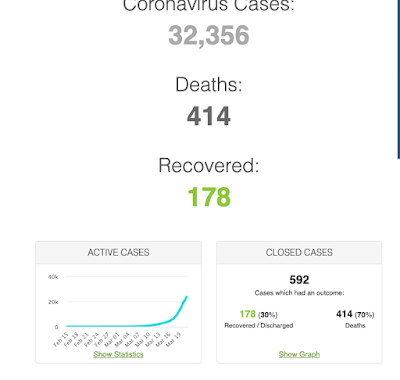 This is the current U.S. data on Coronovirus numbers. This virus- as with any virus - can be modeled as a logistic growth function. A logistic growth function is most commonly used in biology, as any population will initially grow exponentially, but the rate of increase will slow, eventually to 0; at that point, we reach the "carrying capacity." In the case of viruses, that "carrying capacity" would actually be the total number of people infected. After all, viruses needed human hosts to remain "alive" (insofar as viruses are technically not considered alive); once there are no further non-immune hosts available, they would theoretically cease to operate- so to speak. Any physicians reading this are probably cringing at my medical terminology (or lack thereof). Back to the math....
So what is a logistic growth function?
This is the current U.S. data on Coronovirus numbers. This virus- as with any virus - can be modeled as a logistic growth function. A logistic growth function is most commonly used in biology, as any population will initially grow exponentially, but the rate of increase will slow, eventually to 0; at that point, we reach the "carrying capacity." In the case of viruses, that "carrying capacity" would actually be the total number of people infected. After all, viruses needed human hosts to remain "alive" (insofar as viruses are technically not considered alive); once there are no further non-immune hosts available, they would theoretically cease to operate- so to speak. Any physicians reading this are probably cringing at my medical terminology (or lack thereof). Back to the math....
So what is a logistic growth function?
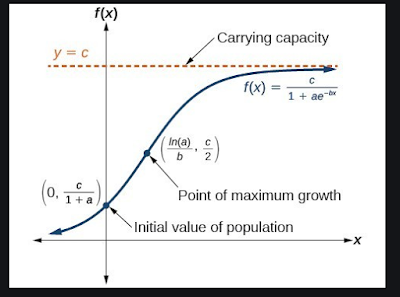 And right now, we are still on the first half (or leg, if you prefer) of the graph, during which dP/dT, the rate of increase, is still increasing. As of today, Coronovirus cases are increasing at a rate of 7500 per day. The "inflection point" would represent the midway point of this crisis. At that inflection point, the rate of increase would stabilize, and the daily rate of new cases would begin to decrease. You see, then, that even if today is the inflection point (which seems unlikely), we would still have another 3 weeks until the graph finally plateaued, and the total Coronavirus cases in our country maxed out at 65,000, with the virus declared contained at that point. That would appear be the best case scenario as of this point. Until we actually reach that inflection point, we would extend our estimate of the crisis' duration, as well as the maximum expected number of Coronavirus cases.
UPDATED 3/26/2020- The number of Coronavirus cases in the U.S. is now 85,268, with dP/dT of over 17,000 and climbing. We are poised to reach P of 100,000 within hours. The function now resembles an exponential function of the form P = P0r^t, where r is between 1.2 and 1.25. We are evidently not approaching an inflection point. Prepare for reported Coronavirus cases to exceed 200,000 in the best-case scenario. Worst case, we may conceivably head into 7 figures.
This happens normally, by the way- with colds, etc. We hear the expression "There's a cold going around." Within a few weeks, much of the population is infected. Why? Because normally we do not shut the country. Colds are normally of minimal danger (aside from for those with severe immune deficiencies); hence, there is no reason to stop business as usual. However, this virus is different. It is far nastier, and with a mortality rate of 4%, allowing 1/2 the population to become infected (which is a figure we hear commonly) in the absence of a shutdown, amounting to roughly 10 million American deaths, would be unacceptable to us.
We hear the expression "flattening the curve." This is precisely what is accomplished by this shutdown. Minimizing human interaction (aka “social distancing”) slows the rate of transmission so that the maximum number of Coronacases- and, more importantly, deaths resulting from such, is minimized. There is a price paid, however- increased duration. To save lives, this shutdown increases the duration before the "carrying capacity" point is reached. Hopefully we all would concur that increasing the duration is worth saving many millions of lives. Also, we hear about hospitals' capacity. By slowing the spread, this also - hopefully- decreases the cases of severe Coronavirus patients who are unable to receive adequate treatment due to shortages of beds, medical supplies, etc.
We hear many officials indicating figures of 9-11 more weeks. This is a probably fairly accurate estimate of the time remaining until containment is attained. One official grimly indicated 18 months, punctuated by multiple waves. This would make sense when considering the expectation that a vaccine to eliminate COVID-19 would likely take 18 months to develop, and meanwhile- even after containment is achieved- some people might potentially bring the virus back into our country, and it would then resume spreading to Americans not previously infected, and then another round of this. Hopefully, with our government wiser from the experience, the response would be more prompt, decisive, and hence more effective than this round.
And this, in a nutshell, is the mathematical representation of the Coronavirus pandemic. If you prefer to hear the non-mathematical details- regarding food shortages, people acting irrationally, the occasional touching story of people reaching out to help others, etc., this will pop up in front of you in today's headlines. No reason for me to provide more of this here. However, if you are reading this, please stay safe. And as Mr. Spock would say, "Live long and prosper!"
And right now, we are still on the first half (or leg, if you prefer) of the graph, during which dP/dT, the rate of increase, is still increasing. As of today, Coronovirus cases are increasing at a rate of 7500 per day. The "inflection point" would represent the midway point of this crisis. At that inflection point, the rate of increase would stabilize, and the daily rate of new cases would begin to decrease. You see, then, that even if today is the inflection point (which seems unlikely), we would still have another 3 weeks until the graph finally plateaued, and the total Coronavirus cases in our country maxed out at 65,000, with the virus declared contained at that point. That would appear be the best case scenario as of this point. Until we actually reach that inflection point, we would extend our estimate of the crisis' duration, as well as the maximum expected number of Coronavirus cases.
UPDATED 3/26/2020- The number of Coronavirus cases in the U.S. is now 85,268, with dP/dT of over 17,000 and climbing. We are poised to reach P of 100,000 within hours. The function now resembles an exponential function of the form P = P0r^t, where r is between 1.2 and 1.25. We are evidently not approaching an inflection point. Prepare for reported Coronavirus cases to exceed 200,000 in the best-case scenario. Worst case, we may conceivably head into 7 figures.
This happens normally, by the way- with colds, etc. We hear the expression "There's a cold going around." Within a few weeks, much of the population is infected. Why? Because normally we do not shut the country. Colds are normally of minimal danger (aside from for those with severe immune deficiencies); hence, there is no reason to stop business as usual. However, this virus is different. It is far nastier, and with a mortality rate of 4%, allowing 1/2 the population to become infected (which is a figure we hear commonly) in the absence of a shutdown, amounting to roughly 10 million American deaths, would be unacceptable to us.
We hear the expression "flattening the curve." This is precisely what is accomplished by this shutdown. Minimizing human interaction (aka “social distancing”) slows the rate of transmission so that the maximum number of Coronacases- and, more importantly, deaths resulting from such, is minimized. There is a price paid, however- increased duration. To save lives, this shutdown increases the duration before the "carrying capacity" point is reached. Hopefully we all would concur that increasing the duration is worth saving many millions of lives. Also, we hear about hospitals' capacity. By slowing the spread, this also - hopefully- decreases the cases of severe Coronavirus patients who are unable to receive adequate treatment due to shortages of beds, medical supplies, etc.
We hear many officials indicating figures of 9-11 more weeks. This is a probably fairly accurate estimate of the time remaining until containment is attained. One official grimly indicated 18 months, punctuated by multiple waves. This would make sense when considering the expectation that a vaccine to eliminate COVID-19 would likely take 18 months to develop, and meanwhile- even after containment is achieved- some people might potentially bring the virus back into our country, and it would then resume spreading to Americans not previously infected, and then another round of this. Hopefully, with our government wiser from the experience, the response would be more prompt, decisive, and hence more effective than this round.
And this, in a nutshell, is the mathematical representation of the Coronavirus pandemic. If you prefer to hear the non-mathematical details- regarding food shortages, people acting irrationally, the occasional touching story of people reaching out to help others, etc., this will pop up in front of you in today's headlines. No reason for me to provide more of this here. However, if you are reading this, please stay safe. And as Mr. Spock would say, "Live long and prosper!"
 This is the current U.S. data on Coronovirus numbers. This virus- as with any virus - can be modeled as a logistic growth function. A logistic growth function is most commonly used in biology, as any population will initially grow exponentially, but the rate of increase will slow, eventually to 0; at that point, we reach the "carrying capacity." In the case of viruses, that "carrying capacity" would actually be the total number of people infected. After all, viruses needed human hosts to remain "alive" (insofar as viruses are technically not considered alive); once there are no further non-immune hosts available, they would theoretically cease to operate- so to speak. Any physicians reading this are probably cringing at my medical terminology (or lack thereof). Back to the math....
So what is a logistic growth function?
This is the current U.S. data on Coronovirus numbers. This virus- as with any virus - can be modeled as a logistic growth function. A logistic growth function is most commonly used in biology, as any population will initially grow exponentially, but the rate of increase will slow, eventually to 0; at that point, we reach the "carrying capacity." In the case of viruses, that "carrying capacity" would actually be the total number of people infected. After all, viruses needed human hosts to remain "alive" (insofar as viruses are technically not considered alive); once there are no further non-immune hosts available, they would theoretically cease to operate- so to speak. Any physicians reading this are probably cringing at my medical terminology (or lack thereof). Back to the math....
So what is a logistic growth function?
 And right now, we are still on the first half (or leg, if you prefer) of the graph, during which dP/dT, the rate of increase, is still increasing. As of today, Coronovirus cases are increasing at a rate of 7500 per day. The "inflection point" would represent the midway point of this crisis. At that inflection point, the rate of increase would stabilize, and the daily rate of new cases would begin to decrease. You see, then, that even if today is the inflection point (which seems unlikely), we would still have another 3 weeks until the graph finally plateaued, and the total Coronavirus cases in our country maxed out at 65,000, with the virus declared contained at that point. That would appear be the best case scenario as of this point. Until we actually reach that inflection point, we would extend our estimate of the crisis' duration, as well as the maximum expected number of Coronavirus cases.
UPDATED 3/26/2020- The number of Coronavirus cases in the U.S. is now 85,268, with dP/dT of over 17,000 and climbing. We are poised to reach P of 100,000 within hours. The function now resembles an exponential function of the form P = P0r^t, where r is between 1.2 and 1.25. We are evidently not approaching an inflection point. Prepare for reported Coronavirus cases to exceed 200,000 in the best-case scenario. Worst case, we may conceivably head into 7 figures.
This happens normally, by the way- with colds, etc. We hear the expression "There's a cold going around." Within a few weeks, much of the population is infected. Why? Because normally we do not shut the country. Colds are normally of minimal danger (aside from for those with severe immune deficiencies); hence, there is no reason to stop business as usual. However, this virus is different. It is far nastier, and with a mortality rate of 4%, allowing 1/2 the population to become infected (which is a figure we hear commonly) in the absence of a shutdown, amounting to roughly 10 million American deaths, would be unacceptable to us.
We hear the expression "flattening the curve." This is precisely what is accomplished by this shutdown. Minimizing human interaction (aka “social distancing”) slows the rate of transmission so that the maximum number of Coronacases- and, more importantly, deaths resulting from such, is minimized. There is a price paid, however- increased duration. To save lives, this shutdown increases the duration before the "carrying capacity" point is reached. Hopefully we all would concur that increasing the duration is worth saving many millions of lives. Also, we hear about hospitals' capacity. By slowing the spread, this also - hopefully- decreases the cases of severe Coronavirus patients who are unable to receive adequate treatment due to shortages of beds, medical supplies, etc.
We hear many officials indicating figures of 9-11 more weeks. This is a probably fairly accurate estimate of the time remaining until containment is attained. One official grimly indicated 18 months, punctuated by multiple waves. This would make sense when considering the expectation that a vaccine to eliminate COVID-19 would likely take 18 months to develop, and meanwhile- even after containment is achieved- some people might potentially bring the virus back into our country, and it would then resume spreading to Americans not previously infected, and then another round of this. Hopefully, with our government wiser from the experience, the response would be more prompt, decisive, and hence more effective than this round.
And this, in a nutshell, is the mathematical representation of the Coronavirus pandemic. If you prefer to hear the non-mathematical details- regarding food shortages, people acting irrationally, the occasional touching story of people reaching out to help others, etc., this will pop up in front of you in today's headlines. No reason for me to provide more of this here. However, if you are reading this, please stay safe. And as Mr. Spock would say, "Live long and prosper!"
And right now, we are still on the first half (or leg, if you prefer) of the graph, during which dP/dT, the rate of increase, is still increasing. As of today, Coronovirus cases are increasing at a rate of 7500 per day. The "inflection point" would represent the midway point of this crisis. At that inflection point, the rate of increase would stabilize, and the daily rate of new cases would begin to decrease. You see, then, that even if today is the inflection point (which seems unlikely), we would still have another 3 weeks until the graph finally plateaued, and the total Coronavirus cases in our country maxed out at 65,000, with the virus declared contained at that point. That would appear be the best case scenario as of this point. Until we actually reach that inflection point, we would extend our estimate of the crisis' duration, as well as the maximum expected number of Coronavirus cases.
UPDATED 3/26/2020- The number of Coronavirus cases in the U.S. is now 85,268, with dP/dT of over 17,000 and climbing. We are poised to reach P of 100,000 within hours. The function now resembles an exponential function of the form P = P0r^t, where r is between 1.2 and 1.25. We are evidently not approaching an inflection point. Prepare for reported Coronavirus cases to exceed 200,000 in the best-case scenario. Worst case, we may conceivably head into 7 figures.
This happens normally, by the way- with colds, etc. We hear the expression "There's a cold going around." Within a few weeks, much of the population is infected. Why? Because normally we do not shut the country. Colds are normally of minimal danger (aside from for those with severe immune deficiencies); hence, there is no reason to stop business as usual. However, this virus is different. It is far nastier, and with a mortality rate of 4%, allowing 1/2 the population to become infected (which is a figure we hear commonly) in the absence of a shutdown, amounting to roughly 10 million American deaths, would be unacceptable to us.
We hear the expression "flattening the curve." This is precisely what is accomplished by this shutdown. Minimizing human interaction (aka “social distancing”) slows the rate of transmission so that the maximum number of Coronacases- and, more importantly, deaths resulting from such, is minimized. There is a price paid, however- increased duration. To save lives, this shutdown increases the duration before the "carrying capacity" point is reached. Hopefully we all would concur that increasing the duration is worth saving many millions of lives. Also, we hear about hospitals' capacity. By slowing the spread, this also - hopefully- decreases the cases of severe Coronavirus patients who are unable to receive adequate treatment due to shortages of beds, medical supplies, etc.
We hear many officials indicating figures of 9-11 more weeks. This is a probably fairly accurate estimate of the time remaining until containment is attained. One official grimly indicated 18 months, punctuated by multiple waves. This would make sense when considering the expectation that a vaccine to eliminate COVID-19 would likely take 18 months to develop, and meanwhile- even after containment is achieved- some people might potentially bring the virus back into our country, and it would then resume spreading to Americans not previously infected, and then another round of this. Hopefully, with our government wiser from the experience, the response would be more prompt, decisive, and hence more effective than this round.
And this, in a nutshell, is the mathematical representation of the Coronavirus pandemic. If you prefer to hear the non-mathematical details- regarding food shortages, people acting irrationally, the occasional touching story of people reaching out to help others, etc., this will pop up in front of you in today's headlines. No reason for me to provide more of this here. However, if you are reading this, please stay safe. And as Mr. Spock would say, "Live long and prosper!"
Tuesday, February 28, 2017
Moody's Mega Math Challenge
Some of us who completed our secondary-level education in the 1980s and 1990s (myself included) had the pleasure of competing in local math competitions. The Greater San Diego Math Field Day was one such example. I personally competed in this event- and later the high school equivalent of the same- in every grade from 6th through 12th grade. The setup was fairly consistent. On one particular Saturday morning in spring, students representing teams from all competing schools would show up at one specified location, usually a public school campus. Students would be ushered into rooms and would be given a challenging timed math test. These tests contained challenging isolated math problems, which tested math skill and knowledge. Then, while students cleared their heads and waited- attending lectures and perhaps having lunch- the tests would be quickly graded. In early afternoon, students and families would assemble in an auditorium and the awards ceremony would ensue. Winning students would receive a ribbon and/or trophy, perhaps a small prize (one year, my 2nd place prize was the game of Helix).
Flash forward to the present. The "low stakes" competitions of the kind described above are increasingly rare, perhaps regarded as obsolete. The "old-fashioned" problems are an intellectual challenge, but how does society benefit from tackling such isolated and seemingly random problems? Over the past several years, a new and high-stakes math competition-which draws thousands of competitors nationwide- has emerged. I refer specifically to Moody's Mega Math Challenge, organized by the Society for Industrial and Applied Mathematics. This competition is held online over the last weekend in February. Students have a 2- to 3-day window in which to compete, but must submit the team's solution within 14 hours of accessing the problem. Once any team member downloads the problem, the clock starts ticking for the entire team. Our math team from California Virtual Academy just competed in this competition- for the 2nd consecutive year! Regardless of the results, the students found this an enjoyable and interesting experience. The problems from past years have been posted. As seen on their website, this year's problem involved investigation of environmental impact and climate change, specifically considering historical sea levels at major national parks and extrapolating future levels via mathematical modeling. Surely the results of students' work on this problem is of enormous value to our country. Indeed, ther are many who scoff at the notion of environmentalism and global warming and the like. However, if the gifted students throughout our country consistently arrive at similar conclusions, this would be something our political leaders should consider. (Yes? At least I would hope so. For our sake as a species....). This is a high-stakes competition. The prizes awarded to winners reflect this. While there is no cost to register to compete, a total of up to $150,000 of prizes are awarded, with prizes ranging from $1000 to $20,000 split amongst team members, to be paid to their future colleges. It should be pointed out, however, that all teams submitting viable solutions are deserving of commendation. As noted above, these problems are not isolated abstractions, but are relevant matters that impact our entire country- and world. Successful students need a well-rounded academic background for this competitions, since they must not only tackle the math, but also write a lengthy, detailed research paper containing all specfied components within the time allotted. Such a feat is indeed impressive.
Wednesday, December 30, 2015
Normalcy Versus Eccentricity: Case Study in Math Applications
The story is told of a man driving on the I-5 freeway, who received a cell phone call from his panicked wife. The woman warned her husband, "I am scared; I heard a news report that there is a crazy driver driving the wrong way on the freeway, right in your vicinity!"
"It's not just one," replied the man, "there are hundreds of them!"
In my math classes, it is oftentimes an interesting experience to pose unexpected questions to my students and make note of their replies. My math students are accustomed to classes commencing with a warm-up quiz via Kahoot. In lieu of a traditional multiple-choice practice quiz, I recently preceded a pre-calculus lesson on conic sections with a single-question philosophical question distinguishing a "normal" versus an "eccentric" person. This would lay the groundwork for the formulae on ellipses, especially that of eccentricity of an ellipse. I challenged students to select and justify which scenario is the more reasonable: "The distinction (between a normal and eccentric person) is mathematically describable", or "I'm normsl and everyone else is crazy; the Voices told me so." Students seemed divided in opinion, with perhaps a slight preference of the latter scenario (eccentricity being arbitrary). One student pointed out that since every individual is unique, complete normalcy is unattainable. Another student suggested a mathematical quantification of normalcy is possible from the standpoint of allowing deviation from the norm within certain limits. This was highly reminiscent of the normal distribution function, despite the fact that such a function is beyond the scope of this course.
Why do I discuss this particular application concept here? We math teachers often contend with students who opt to avoid or minimize work done in math classes. Justifications for such inaction are disturbing. "I hate math." "I can't do math." "The subject is boring." "The subject is dry." Then, of course, we have the evolved versions of the "homework dogs" that back in the 1980s would pop up in front of unsuspecting students, snatch and eat their homework, then vanish into the parallel universes from which they had come. In this generation, we have instead computer bugs that delete files from students' computers, render computers totally inoperable for weeks at a time, mysteriously delete submitted assignments from drop boxes and delete all evidence of tests taken and messages sent to teachers about missing items. I have heard all of this, and more. Give me any excuse for not working; I have probably heard it, or some slight variation, at some point in time.
In addition to establishing and maintaining standards of thoroughness in math classes, it is highly advisable to convey to students the applications of the content material to their everyday lives. This is not always easy. Many math lessons are invariably "dry," as they often involve proofs, mechanics, simplifying expressions, and so on. However, whenever possible, if one can effectively relate mathematical concepts to real life scenarios, there is the greater likelihood of better engaging the students. Humor can be very helpful.
Oh- by the way, I am not eccentric in the slightest degree. I am perfectly normal. You are all crazy. The Voices told me so.
Friday, January 2, 2015
Mathematics Education and Virtual Schools
In an earlier post, I had given a somewhat cynical depiction of mathemtics education in the traditional public school setting. With 29 nations (including such countries as Vietnam and Poland) having surpassed the US in math based on tests administered worldwide, there would seem to be cause for concern and considerable room for improvement. These national rankings highlight educational stagnation in the US since 2003. I thought it appropriate, given my nearly 1 1/2 years at California Virtual Academy, to consider the value of virtual schools such as this one in improving US students' performance in mathematics.
It should be acknowledged at the outset that there is likely no "magical" solution, unless someone invents a Star Trek device such as the "Teacher" (episode: Spock's Brain) to rapidly save course content directly into the human brain. Stagnation in US performance has not been owing to a lack of innovative educational theory. "New math" curricula attempting to replace "old-fashioned" textbooks and guide students to "discover" mathematical concepts and formulae in lieu of memorization have unsuccessfully been implemented in prior decades, including as recently as the 1990s. Most of these, upon their failure, were followed by a return to traditional instruction, with textbooks, notes, old-fashioned homework/practice problems. We have all seen the results of "No Child Left Behind", attempting to require schools to improve performance based on uniform "standards", guaged by students' performance on high-stakes standardized testing, from 2004 through the present.
A key concept incorporated into teacher trainings over the past decade is that teachers must now relinquish their traditional role as "Sage on the Stage" in lieu of their new role as "Guide on the Side", the latter role being deemed more effective in this day and age. Our being outperformed by countries, including many that cling to old-fashioned techniques, would seem to throw this concept into question. Also, it is noteworthy that in most public school classrooms there seems to be little evidence of this new concept's effective implementation. Traditional textbooks, practice work, tests, and so on are still followed, with relaxation of behavioral expectations being the primary evidence of "facilitating" student learning. Since it is acknowledged that students will not shut their mouths for more than a few minutes, teachers endeavor to complete required instruction within that student-imposed time constraint, and then turn them loose for "cooperative learning" (usually a lot of talking accompanied by sporadic work on practice problems, etc.). Many teachers "choose their battles", allow such items as headphones, food/drink, etc. in class provided students do their work and are not overtly disruptive or disrespectful.
The question to consider, then, is whether virtual schools represent a possible solution, or at least a positive factor in improving US students' performance in mathematics overall. I do not pretend to know the answer to this. I can point out some major advantages to students pursuing this option. The setup here seems to genuinely embody the "Guide on the Side" teacher model, rather than in most brick-and-mortar schools characterized by lip service to this notion in the absence of its effective implementation. Class attendance is often optional. Students who would normally disrupt physical classrooms usually do not attend virtual class sessions; this, they are not in the classroom to cause trouble or detract from the education of the motivated, well-behaved students. Those who in rare cases attend and then cause trouble can be private-messaged, silenced, and even discreetly ejected from the room with a push of a button. Indeed, some students who once were at-risk and disrupted traditional classrooms are thriving within the virtual school environment and are on track to themselves become strong candidates for college admission. Students aspiring to attain their mathematical potential enjoy the benefit of small live class sessions, ample opportunity to ask questions, even (if desired) questions beyond the scope of the course. It is noteworthy that in some local school systems (at least in California) students are being assigned individual laptops in lieu of multiple textbooks, must carry these laptops to and from school daily, and even submit assignments online into "dropboxes", much like assignments are submitted in virtual schools. Thus, the virtual school model is interestingly being adopted at least to some degree within brick-and-mortar schools.
Tuesday, April 29, 2014
Personal Finance- National & Global Finance
Just as there are indicators to gauge a business's finances, so are there indicators to measure the financial health at the national and even global level. The U.S. government- particularly the Federal Reserve, White House, and Congress- monitor these indicators and act (hopefully) to minimize the damage of economic crises such as the recent "Great Recession" (or Not-So-Great Depression), as well as to promote the long-term well-being of the U.S. economy. Oftentimes these indicators lead to disagreement amongst government officials and members of the Federal Reserve, as the course of action in each such case may be debatable and involve weighing one risk versus another. In response to a weak economy, the Federal Reserve will increase the supply of money by buying government securities, lowering the interest rate, and lowering the reserve requirement. This tends to increase economic activity, including investment, but runs the risk of undermining the economy by causing inflation. In response to a superheated economy, often characterized by excessive inflation, the Federal Reserve can contract the economy through reducing the supply of money by selling government securities, raising the interest rate, and raising the reserve requirement. As happened in 2001, this has the danger of causing a recession. Determining the ideal course of action is a non-trivial problem, involving navigating between the dangers of each possible scenario.
The U.S. is one major participant in this global economy. Given the interconnectedness characterizing the current global economy, economic crises in one country can impact large portions of the world. The health of the global economy is thus of importance to everyone. Free trade is regarded as beneficial to everyone, whereas tariffs are seen as ultimately detrimental to all countries levying them. The reason is that while a country may levy tariffs and other protective measures to protect domestic companies from international competition, other countries will ultimately retaliate and impose protective trade measures of their own; the result (akin to the Prisoner's Dilemma in game theory) is that all players in the national economy lose in the end.
The relative strength of one country's currency relative to another can be seen in shifts in the exchange rate between countries. If country A's currency gains strength while currency B's currency weakens buy comparison, $1 in country (using $ in the generic sense) will buy more $s in country B. This also provides an exchange rate risk in investing international; a country A resident who invests $1000 in country B and then tries to liquidate his investment will recover an amount less than his original investment. In addition to exchange rate risk, an international investor will want to invest in a country with a low inflation rate, high interest rate (thus, high real interest rate, defined as nominal interest rate - inflation rate), stable government (i.e. no regular unrest in the streets) which respects the market economy and will not arbitrarily seize assets held by others.
Monday, April 28, 2014
Personal Finance- Business Finance
The "finance" side of business involves a great amount of mathematical content. The financial health or situation of a business is evaluated mathematically. Crucial to this analysis is the basic equation Assets = Liabilities + Equity
Put quite simply, this equation declares that the total value of assets (cash, equipment, inventory, real estate, etc.) of a business are the sum of the value owned by the business owners plus the amount borrowed from others, usually at a significant rate of interest. In any given period, profit = revenues (usually from sales) - expenses. We can then examine the financial well-being of the business based on any combination of ratios. Common ratios to consider are Return on Assets or Return/Assets, and Return on Equity or Return / Equity, both ratios usually measured over a period of 1 year. These ratios provide a benchmark measurement for investors, whose valuation of any particular company is largely based on these ratios. Financial analysts regard the value of a company, as with any investment, as equal to the expected present value of all future cash flows. Such cash flows can come from regular dividend payments and/or increase in market value (i.e. Stock price) in the company. The ratios which investors like to see will naturally vary by industry, as they are likely to demand lower return on equity of more conservative companies as compared to riskier, high-growth companies. Debt ratio = liabilities/assets is a measure of what proportion of a company's assets is financed through debt; the higher this ratio (and especially if this ratio is more than 1), the more leveraged the company is to be, and thus the riskier an investment the company becomes.
Wednesday, April 23, 2014
Personal Finance- Insurance
Throughout one's life, unexpected events inevitably occur. Accidents happen, things break down spontaneously, illnesses occur, and eventually we face death. Ultimately, though caution may reduce the frequency of such events and increase lifespan, the risk of such events will always exist. Insurance - car insurance, medical insurance, property insurance, life insurance- help by compensating us financially for unexpected major events in return for regular premium payments made to the insurance companies. (Car insurance is legally required, at least in California). Possession of insurance helps to provide a degree of security, by guarding us against the risk of severe financial losses resulting from unexpected, often catastrophic, events. We pay insurance companies to take the risk for us; the payments- or "premiums"- are the price the insurance companies demand of us as compensation for this risk. True, given that the insurance companies must make a profit (if only to pay the salaries and operating expenses within the business), the premium must represent an amount greater than the expected value of the company's payout to you. However, given that we are risk averse- particularly if we have family members who may suffer if we incur financial losses- most of us are wise to have insurance, particularly medical insurance, life insurance, property insurance, and the like. Having insurance also allows us to more accurately budget based on our expenses. Our insurance premiums are fairly predictable; we can surely add up the premiums for each of our insurances and determine the total cost of "insurance" for the year. This value is subject to far less variation compared to owning no insurance (except car insurance, as the law requires that), and then having to prepare for each of the possible contingency scenarios of facing unexpected huge medical expenses; having one's house damaged or destroyed in a fire, earthquake, flood, etc.; or laying the groundwork for your family members to continue on in the event of your disability or passage. Thus, it is accurate to say that the primary advantages to purchasing insurance are the security of not needing to fear financial harm resulting from major losses combined with allowing for more accurately budgeting (for a household) based on anticipated expenses, with far less variation than would be the case if deciding to decline insurance and simply "take one's chances."
Saturday, April 19, 2014
Personal Finance- The Business World
Owning and/or managing a business can be highly profitable, but requires accepting the risk of failure with the accompanying heavy financial losses owing to any of a number of factors. A successful business follows such practices (not all-inclusive) as a clearly defined set of short- and long-term goals, effective marketing to attract the business's target market, responsible financial decision-making, differentiating one's product from that offered by one's competitors. Given the potential of accidents and/or lawsuits owing to numerous unanticipated incidents, purchasing of liability insurance is essential. The smallest businesses are typically sole proprietorships, owned by a single person and essentially inseparable from the owner. Sole owners can enjoy huge profits, but also assume full personal and financial liability for the company. In lieu of being the sole owner, small firms can be owned by 2 or more partners, sharing the profits but also the liability. Large companies, "corporations", are usually owned primarily by a large number of investors who own equity in the company in the form of shares of stock, each representing a tiny piece of the company. Corporations have an existence separate from that of the owners; thus, although the owners share the profits or losses sustained by the company as a whole, personal liability attached to the company does not apply to the owners directly. Thus, fraud within a company does not implicate each of the individual owners of that company.
Personal Finance- Careers
The very nature of the "career" has changed over the past generation. Loyalty of employers to employees, and vice versa, declined during the 1980s and 1990s. With the exception of government positions, teaching, military careers, or the like, it became increasingly common for people to switch companies a few times or more during the course of their careers. Unfortunately, during the boom of the late 1990s, new college graduates, even with math or math-related degrees from highly rated universities were informed they were at a disadvantage when applying for the entry to junior level positions they were targeting owing to their lack of "experience." These companies were not interested in investing any significant amount of training into these highly intelligent young people who had followed society's "rules" and focused on their well-rounded studies while in college. Ironically, the young people who ultimately had the advantage were the less studious C-level college students, who barely passed their humanities classes, but stayed awake extremely late in their dorm rooms, engaging in such activities as computer games, experimenting with various cutting-edge computer technology and software, or other similar endeavors.
Meanwhile, the very process of applying for employment changed rapidly. Up through the early 1990s, a motivated qualified job-seeker (especially with a strong college degree) who scanned through the Sunday classified section of the newspaper, cutting out all relevant job postings, and applied by sending an updated resume with appropriate cover letter to every job for which he was a good match could reasonably expect to be called in for interviews and secure employment within weeks to perhaps a few months. Each such job posting attracted perhaps a few dozen applicants, if that. By the late 1990s, online job postings replaced newspapers as the more effective method of accessing job openings. A single search engine had the capability of immediately accessing many individual newspapers or job listings, combined with the convenience of allowing keyword searches. This initially seemed to simplify the job search process. However, from 1999 on, as the internet increasingly became the primary method of applying for employment, employers became less receptive to being contacted by job seekers through any other means. "No phone calls" appeared frequently on job postings. Even at job fairs, recruiters could increasingly be heard to advise most job seekers to "apply online" and provide them with the company's career website.
The "Great Recession" or "Not So Great Depression" (however you prefer to term it) struck in full force from 2007 through 2009, severely affecting the careers, job prospects, and financial well-being of a large proportion of the American population. An overly simplistic analysis would attribute the resulting and subsequent long-term unemployment and underemployment- 2 to 5 years in many cases- of even highly educated Americans to this period of extreme economic weakness. However, a more thorough analysis- as pointed out by spokespeople in the National Employment Council- would consider the developments of the prior 15 years, particularly the factors enumerated above.
Thursday, April 10, 2014
Personal Finance- Credit and Loans
We previously examined the case of accumulation and investment of savings. However, most of us- even those who are fortunate enough to secure well-paying jobs- would find it inconvenient to delaying purchasing cars, a house, or have our kids delay college until amassing enough savings to pay the entire cost outright. This is the purpose of credit and loans; it allows people with a solid income and history of responsible financial conduct to borrow large amounts of money from banks to purchase high-ticket items, and subsequently repay the bank the amount owed plus interest. Interest rates are typically 5% or higher for home loans. Credit cards are essentially loans, in which the borrower (credit card holder) controls the balance owed by paying off the credit card in part or in whole every month. This degree of control comes with a price; typical credit card interest charges are 18% of the unpaid credit card balance, and penalties are levied every month in which the minimum payment is not made. One's ability to qualify for loans, especially home and car loans, is largely determined by one's credit score, a numerical score as calculated by the 3 major credit bureaus, whose value is based on a person's financial/credit history. A person with many cases of defaults, late payments, etc. will have a low credit rating, with harsher penalties for severe and/or repeated defaults. A person with a clear or nearly clear credit history will tend to have a high credit score, and thus be most likely to be approved when applying for a loan. A normal credit score is in the 600-700 range; anything above 700 is considered "good", with anything below 600 considered "poor." A person with a poor credit score is considered a risky investment for a bank or other lender; thus, such a person who does find a means for securing a loan can expect to have high interest payments. This is a natural consequence of the direct correlation between risk and return; in a similar sense as when you might invest in a risky stock, a person with a poor credit score is considered a high-risk investment for a bank, and thus should entitle a bank to demand a high return rate in consequence of approving such a risky individual for a loan. If you should find yourself with a low credit score owing to a history of default, please beware of companies offering to "repair" your credit score for a price in order to help you qualify for a loan. Such an arrangement is a waste of your money, which is more effectively spent in paying off your debts directly. Any errors on your report can be corrected by you directly contacting the credit bureaus and sending documentation to correct such erroneous data. Credit scores based on accurate data cannot be "repaired" except through paying off your creditors and proving financial responsibility (no additional defaults) over time.
Monday, April 7, 2014
Personal Finance- Financial Planning
As a member of a household- whether as an individual or a man or woman of a nuclear family unit- it is advisable to make financial plans based on current income and expenses, as well as projections of future income and expenses. Income is usually in the form of job wages/salary, though unearned income from investments may also occur, especially for those fortunate enough to own stock or receive interest from bank or other accounts or other sources. A portion of one's income must be paid (by law) to the U.S. federal government as well as one's state government on an annual basis; you- perhaps (recommended) with an accountant's assistance- are required to complete the required paperwork, including a 1040EZ or equivalent form, in calculating taxes owed to the government (or refund owed to you if more money was already withheld than was needed). In general, expenses consist of anything requiring payment of money, including planned expenses such as food, utilities, insurance, etc. as well as unplanned expenses such as unplanned repairs, replacement of broken items, etc. The amount of money you/your household is able to save towards long-term goals (i.e. college tuition for kids, retirement, etc.) equals after-tax income minus the sum of all expenses for the year. (There are various options for investing these savings to possibly obtain a substantial return over time). There are possible objections to the notion of making long-term goals. Examples are: "How can I accurately anticipate unplanned expenses?" "How can I know what my salary will be at any future point in time? What if I am laid off and unemployed or underemployed for a long period of time?" This last question might be posed much more frequently in this day and age, following the recent and present situation of highly educated people facing extended unemployment despite their best efforts. The trauma of the recent economic "Great Recession" (or "not-so-great Depression", as others have termed it) should have taught us to save more given the unanticipated setbacks that may strike in the future; however, recent surveys and news reports indicate a general return to complacency and perhaps excessive spending. If this assessment is accurate, we may expect to pay the price as the effects of the next recession are magnified due to current poor financial planning.
Saturday, April 5, 2014
Personal Finance- Saving & Investing
You will hopefully achieve the situation where- owing to your earnings exceeding your total expenses over an extended period- you begin to amass some savings. You then will have options as to what to do with your savings. In general, there is a direct correlation between risk and expected returns. You can fairly accurately describe the situation visually by drawing an upward sloping line, represented on a graph such that risk is along the horizontal axis and expected returns on the vertical axis. Low risk/low return investments include savings accounts and investment CDs at the extreme lower left, with a risk of virtually zero (if under $250,000 at an FDIC-insured bank). Moving slightly up on the line, we have money market funds; money that has been deposited into investment banks and not presently invested in stocks, bonds, etc. is often automatically held in money market funds when being held on the sidelines. While superficially almost indistinguishable from savings account and almost equally liquid, they do involve investment in short-term notes and bonds, and thus have a slight risk. Returns are better than most savings accounts, commensurate with CDs of several months (with the benefit that your money is not tied up for several months with these funds). Higher returns come with the price of slight risk; losses are rare, but possible. In 2008, at the height of the recent financial crisis, some money market funds lost as much as 3% in value. Although significant, this is far less than the losses of 50% or more faced by investors and retirees highly invested in the stock market.
Moving further up this line, highly rated "safe" bonds, such as municipal and government bonds, offer higher returns, well over 2%. (Being tax-free, this usually converts to over 3% on taxable bonds). The government being unlikely to collapse and default, we consider these bonds safe. Corporate bonds of large companies are a bit further up, as there is the potential of even such large companies failing unexpectedly; thus, we would expect higher interest rates from such corporate bonds. Moving up further still, we reach "junk bonds"- bonds with low ratings, usually owing to uncertainty regarding a company's stability. For accepting such uncertainty, investors expect the highest returns among bonds. Approaching the upper right area of this line, high risk/high returns, we find stocks. Moving up along the line, we first pass conservative stocks (large companies unlikely to fail), and then progressively speculative stocks, with progressively risky stocks valued to provide increasing expected returns. Finally, at the upper right end we find the most speculative investments, such as venture capital, money offered by investors in return for equity in companies with an at-best shaky likelihood of success. Venture capitalist demand extremely high returns, with 40-50% being reasonable, given the strong possibility they will lose their entire investment.
The decision of how to invest is ultimately up to you. You must decide how much risk you are willing to accept in order to increase your expected returns. Investment firms managing large portfolios, such as family trusts, tend to diversify and hold a mixture of bond and stock funds, a "moderate" approach allowing for moderate returns with moderate risk; you might find such an approach for savings you want to have appreciate in the long-term without excessive risk.
Use of stockbrokers in brokerage firms for purchasing individual stocks or stock indices has fallen drastically over the past decade. In lieu of paying stockbrokers hundreds of dollars per trade, investors can invest with online investment firms, with commissions as low as $10 per trade, and financial information once provided by stockbrokers is now easily accessible online.
Personal Finance- Banking
Upon reaching your 18th birthday, one of your first actions should be to open bank account(s) (unless you already have minor or custodian accounts which will fall under your control the day you turn 18). You will find a bank account essential for several purposes- writing checks or transferring funds to pay bills, depositing paychecks, safely storing your savings and withdrawing cash when needed, and establishing a financial history in your own name prior to applying for credit. The so-called "Big 4" banks (the huge, 4 largest banks)- namely Bank of America, Citibank, Wells Fargo, and Chase- are usually the most convenient ones to establish accounts, given the easy access to these banks, ATM machines, online banking, etc. throughout the country. However, since these banks have minimum balance requirements often as high as $300 for even basic accounts, with monthly service fees assessed if ever your balance falls under this amount, if your savings are less than this you may be better off starting off at a credit union or other smaller bank with lower minimum balance requirements.
You may have noticed that I omitted what was traditionally a strong motivation for opening bank accounts- namely, interest payments. In response to the recent "Great Recession", the Fed opted to lower the interest rates to barely above zero, and hold them there for an extended period. Thus, banks nowadays pay us a ridiculously low interest rate of 0.01% to 0.1% (not a typo), even though they still make at least 4% interest on home loans and over 15% on credit card interest charges. The interest we are paid is surely more than eaten up by the cost of gas to drive to the nearest bank or even corner ATM machine. Thus, for the past 6 years interest has practically vanished as a benefit to holding bank accounts. The other benefits to opening personal accounts still apply, however.
Traditionally, however, it has been advisable to maintain a checking account with funds to which you may need immediate access, and perhaps a combination of savings account and/or investment CD's to provide significant income from interest. CD's offer the highest return, as compensation for agreeing to not touch the CD account prior to the maturity date, or face stiff penalties (typically the entire amount of the interest paid) for withdrawing early; use of CD's and high-interest savings accounts should be adequate to provide returns slightly higher than the inflation rate, thus preventing inflation from eating away at your savings..
All of the above-described accounts are considered low-risk, low-return investments. The Big 4 banks (or any other bank you use) should protect your accounts up to $250,000 per person per account type through the FDIC, meaning that if the bank fails the government will reimburse your money, up to $250,000. You should see a sign in the bank itself advertising this fact; if not, the bank should be avoided. If your assets exceed $250,000, you should spread out your funds amongst multiple banks and/or account types, or perhaps in a money market fund or other investment in an investment account (to be discussed later).
Many banks do offer a high-risk, high-return investment option. They will offer to invest your savings (if sufficiently high in amount, usually several thousand dollars or more) in mutual fund accounts- basically, in the stock market(s). These accounts are not FDIC insured, and may lose value; they will tend to fluctuate with the stock market. There is, for example, a 529 fund which will invest money to be used for your kids' education, with the idea that the stock markets should appreciate substantially by the time any current kids reach college age. While on average the return will be higher from such an investment, there is a strong element of gambling involved; you need to decide whether you are willing to risk losing money to potentially reap the benefits from such speculative investments. The bank, by the way, takes a percentage of this investment, even if they lose money for you.
Subscribe to:
Posts (Atom)