Tuesday, April 14, 2020
Mathematical Modeling of COVID-19 addendum
We are now over a month into the pandemic crisis in the U.S., and - with more data now to work with- it is becoming possible to more easily and accurately extrapolate the end result of this cycle. We seem to have just a few days ago- around April 10- reached the inflection point in terms of total cases, and are just now reaching the inflection point in terms of total deaths. Insofar as that marks the halfway point of the cycle, we can thereby project a total of 1 to 1.1 million total cases in this country, with a resulting 50,000-60,000 American deaths by the time the virus is contained. We can likely anticipate containment around mid-May. Most mathematicians - if asked to project given current data- would likely offer a similar projection. However, we would need the medical professionals and other scientists to provide further data to consider the future beyond that. What is the potential of subsequent waves of infection? How long until there is a vaccine to protect the public from this virus? We can only work with the data we are given.

Tuesday, April 7, 2020
2020 MathWorks Math Modeling Challenge- Electric Vehicles and the Environment
As mentioned in an earlier post, I (and probably many others with a math background) have a keen interest in the annual math modeling challenge managed by the Society for Industrial and Applied Mathematics. We have had math teams representing our school (California Virtual Academies) competing in this event during the last 5 consecutive competitions. My interest in the topics chosen is not merely as a math team coach, but in considering the major challenges facing our civilization which are hopefully surmountable via a combination of mathematical and scientific knowledge, coupled with proper ethical conduct and implementation by our leadership. The topics covered are tackled by our country's teams, representing some of the most gifted high school students in the United States. Their mathematical modeling yields results which are worthy of our government's serious consideration. Do they have the wisdom to examine these results, or at least consider the basic conclusions of the winning teams? Or will they brush aside the results, and simply develop the legislation based on their party lines' positions?
This year's competition- like that of 3 years ago- is related to the oft-covered issue of global climate change. We see this issue in the news almost daily. Climate change is unfolding before our eyes. Very bizarre weather patterns are increasingly manifesting themselves- record heat waves, increasing intensity of severe storms, wildfires, rising ocean levels as our ice caps are melting. Meanwhile, extinction of numerous species is acceleration Long-term concerns include a continuation of the above, coupled with rising sea levels, flooding of human coastal communities. While this is occurring, we are also depleting our nonrenewable resources- especially fossil fuels, the primary culprit of climate change (via increased carbon dioxide in the atmosphere). These facts are undeniable. The argument is no longer one of environmentalism versus denial of the threat of climate change. Instead, the argument is between ardent environmentalism versus those who concede the threat of climate change but quite ironically portray the situation as too hopeless to address, owing to the financial cost of addressing these issues. Moderation and pragmatism - as exemplified (hopefully) by mathematicians- is all too lacking.
Whereas the problem of 2017 examined the evidence of climate change as exhibited by rising sea levels, this year's competition instead focuses on a major piece of the solution- namely, conversion of gasoline-powered diesel trucks to electric-powered ones. The competitors were challenged to examine the speed at which diesel-powered trucks would be converted to electric. Next, they were instructed to determine the number of charging stations needed, and the number of chargers needed at each station, to accommodate the needs of semi-trucks along 5 major corridors. These corridors were San Antonio, TX, to/from New Orleans, LA; Minneapolis, MN, to/from Chicago, IL; Boston, MA, to/from Harrisburg, PA; Jacksonville, FL, to/from Washington, DC;
Los Angeles, CA, to/from San Francisco, CA. Lastly, they were challenged to prioritize which corridor was most important to develop first.
This problem is not a mere theoretical exercise. For those who have been following, the Doomsday Clock- which represents the danger of humanity's self-destruction- this January was moved forward from 11:58 PM to 11:58:20. It is now 100 seconds to midnight. The primary danger to our civilization is nuclear war, followed by climate change. These are interrelated, insofar as climate change would likely lead to competition for resources, leading to a situation in which war is increasingly likely to occur. This is a grave long-term danger that we need to tackle in a reasonable and pragmatic way. It is not a Democratic issue, or Republican issue, but rather an American issue and, indeed a Human issue. At the moment, we are witnessing how humans behave during a comparatively minor crisis. Hoarding and human indecency are manifesting themselves, even as shortage of supply begins to occur. It is not my intention in any way to minimize the impact of tens of thousands of deaths, millions of seriously ill people, and social isolation over a period of many months. Eventually- within the next 12-18 months- this situation will resolve. However, climate change looms ahead as a much bigger crisis which should be regarded as an existential threat. We have resources- not merely financial and technological resources, but also brilliant students to figure out the best methodology to tackle these issues. God willing, our leaders should have the wisdom to turn to our scientists and mathematicians (of all ages) and figure out a pragmatic set of policies to implement their recommendations. Of course, we need policies that will stick permanently, not ones that will be implemented by one party, dismantled by the next administration, while we find ourselves sinking deeper and deeper into a hole. If we learn just one thing from this present crisis, it should be the need for proper planning and working together with our scientists and mathematicians who have been charged with the task of tackling society's greatest threats.
Sunday, March 22, 2020
Mathematical Modelling and the Coronavirus covid-19 Pandemic
It would be safe to say that Americans are presently living in a state of anxiety and fear. I am admittedly far from immune to this from my end- on behalf of my entire household and family (and, incidentally, myself). However, it is worthwhile to step back a bit (in many ways) and tackle this- as mathematicians do- from a mathematical perspective.
Perhaps then, the conflicting news reports will begin to make some sense.
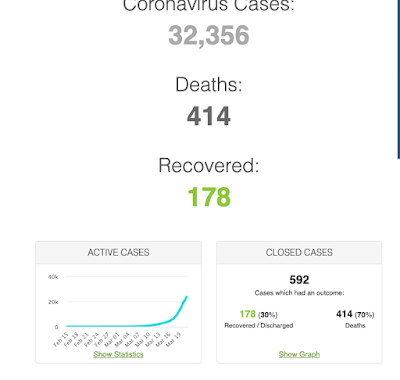 This is the current U.S. data on Coronovirus numbers. This virus- as with any virus - can be modeled as a logistic growth function. A logistic growth function is most commonly used in biology, as any population will initially grow exponentially, but the rate of increase will slow, eventually to 0; at that point, we reach the "carrying capacity." In the case of viruses, that "carrying capacity" would actually be the total number of people infected. After all, viruses needed human hosts to remain "alive" (insofar as viruses are technically not considered alive); once there are no further non-immune hosts available, they would theoretically cease to operate- so to speak. Any physicians reading this are probably cringing at my medical terminology (or lack thereof). Back to the math....
So what is a logistic growth function?
This is the current U.S. data on Coronovirus numbers. This virus- as with any virus - can be modeled as a logistic growth function. A logistic growth function is most commonly used in biology, as any population will initially grow exponentially, but the rate of increase will slow, eventually to 0; at that point, we reach the "carrying capacity." In the case of viruses, that "carrying capacity" would actually be the total number of people infected. After all, viruses needed human hosts to remain "alive" (insofar as viruses are technically not considered alive); once there are no further non-immune hosts available, they would theoretically cease to operate- so to speak. Any physicians reading this are probably cringing at my medical terminology (or lack thereof). Back to the math....
So what is a logistic growth function?
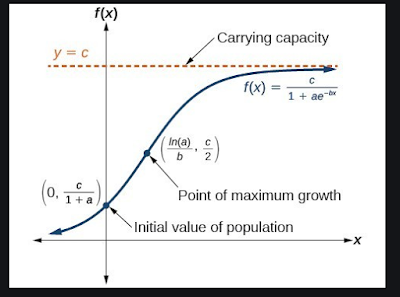 And right now, we are still on the first half (or leg, if you prefer) of the graph, during which dP/dT, the rate of increase, is still increasing. As of today, Coronovirus cases are increasing at a rate of 7500 per day. The "inflection point" would represent the midway point of this crisis. At that inflection point, the rate of increase would stabilize, and the daily rate of new cases would begin to decrease. You see, then, that even if today is the inflection point (which seems unlikely), we would still have another 3 weeks until the graph finally plateaued, and the total Coronavirus cases in our country maxed out at 65,000, with the virus declared contained at that point. That would appear be the best case scenario as of this point. Until we actually reach that inflection point, we would extend our estimate of the crisis' duration, as well as the maximum expected number of Coronavirus cases.
UPDATED 3/26/2020- The number of Coronavirus cases in the U.S. is now 85,268, with dP/dT of over 17,000 and climbing. We are poised to reach P of 100,000 within hours. The function now resembles an exponential function of the form P = P0r^t, where r is between 1.2 and 1.25. We are evidently not approaching an inflection point. Prepare for reported Coronavirus cases to exceed 200,000 in the best-case scenario. Worst case, we may conceivably head into 7 figures.
This happens normally, by the way- with colds, etc. We hear the expression "There's a cold going around." Within a few weeks, much of the population is infected. Why? Because normally we do not shut the country. Colds are normally of minimal danger (aside from for those with severe immune deficiencies); hence, there is no reason to stop business as usual. However, this virus is different. It is far nastier, and with a mortality rate of 4%, allowing 1/2 the population to become infected (which is a figure we hear commonly) in the absence of a shutdown, amounting to roughly 10 million American deaths, would be unacceptable to us.
We hear the expression "flattening the curve." This is precisely what is accomplished by this shutdown. Minimizing human interaction (aka “social distancing”) slows the rate of transmission so that the maximum number of Coronacases- and, more importantly, deaths resulting from such, is minimized. There is a price paid, however- increased duration. To save lives, this shutdown increases the duration before the "carrying capacity" point is reached. Hopefully we all would concur that increasing the duration is worth saving many millions of lives. Also, we hear about hospitals' capacity. By slowing the spread, this also - hopefully- decreases the cases of severe Coronavirus patients who are unable to receive adequate treatment due to shortages of beds, medical supplies, etc.
We hear many officials indicating figures of 9-11 more weeks. This is a probably fairly accurate estimate of the time remaining until containment is attained. One official grimly indicated 18 months, punctuated by multiple waves. This would make sense when considering the expectation that a vaccine to eliminate COVID-19 would likely take 18 months to develop, and meanwhile- even after containment is achieved- some people might potentially bring the virus back into our country, and it would then resume spreading to Americans not previously infected, and then another round of this. Hopefully, with our government wiser from the experience, the response would be more prompt, decisive, and hence more effective than this round.
And this, in a nutshell, is the mathematical representation of the Coronavirus pandemic. If you prefer to hear the non-mathematical details- regarding food shortages, people acting irrationally, the occasional touching story of people reaching out to help others, etc., this will pop up in front of you in today's headlines. No reason for me to provide more of this here. However, if you are reading this, please stay safe. And as Mr. Spock would say, "Live long and prosper!"
And right now, we are still on the first half (or leg, if you prefer) of the graph, during which dP/dT, the rate of increase, is still increasing. As of today, Coronovirus cases are increasing at a rate of 7500 per day. The "inflection point" would represent the midway point of this crisis. At that inflection point, the rate of increase would stabilize, and the daily rate of new cases would begin to decrease. You see, then, that even if today is the inflection point (which seems unlikely), we would still have another 3 weeks until the graph finally plateaued, and the total Coronavirus cases in our country maxed out at 65,000, with the virus declared contained at that point. That would appear be the best case scenario as of this point. Until we actually reach that inflection point, we would extend our estimate of the crisis' duration, as well as the maximum expected number of Coronavirus cases.
UPDATED 3/26/2020- The number of Coronavirus cases in the U.S. is now 85,268, with dP/dT of over 17,000 and climbing. We are poised to reach P of 100,000 within hours. The function now resembles an exponential function of the form P = P0r^t, where r is between 1.2 and 1.25. We are evidently not approaching an inflection point. Prepare for reported Coronavirus cases to exceed 200,000 in the best-case scenario. Worst case, we may conceivably head into 7 figures.
This happens normally, by the way- with colds, etc. We hear the expression "There's a cold going around." Within a few weeks, much of the population is infected. Why? Because normally we do not shut the country. Colds are normally of minimal danger (aside from for those with severe immune deficiencies); hence, there is no reason to stop business as usual. However, this virus is different. It is far nastier, and with a mortality rate of 4%, allowing 1/2 the population to become infected (which is a figure we hear commonly) in the absence of a shutdown, amounting to roughly 10 million American deaths, would be unacceptable to us.
We hear the expression "flattening the curve." This is precisely what is accomplished by this shutdown. Minimizing human interaction (aka “social distancing”) slows the rate of transmission so that the maximum number of Coronacases- and, more importantly, deaths resulting from such, is minimized. There is a price paid, however- increased duration. To save lives, this shutdown increases the duration before the "carrying capacity" point is reached. Hopefully we all would concur that increasing the duration is worth saving many millions of lives. Also, we hear about hospitals' capacity. By slowing the spread, this also - hopefully- decreases the cases of severe Coronavirus patients who are unable to receive adequate treatment due to shortages of beds, medical supplies, etc.
We hear many officials indicating figures of 9-11 more weeks. This is a probably fairly accurate estimate of the time remaining until containment is attained. One official grimly indicated 18 months, punctuated by multiple waves. This would make sense when considering the expectation that a vaccine to eliminate COVID-19 would likely take 18 months to develop, and meanwhile- even after containment is achieved- some people might potentially bring the virus back into our country, and it would then resume spreading to Americans not previously infected, and then another round of this. Hopefully, with our government wiser from the experience, the response would be more prompt, decisive, and hence more effective than this round.
And this, in a nutshell, is the mathematical representation of the Coronavirus pandemic. If you prefer to hear the non-mathematical details- regarding food shortages, people acting irrationally, the occasional touching story of people reaching out to help others, etc., this will pop up in front of you in today's headlines. No reason for me to provide more of this here. However, if you are reading this, please stay safe. And as Mr. Spock would say, "Live long and prosper!"
 This is the current U.S. data on Coronovirus numbers. This virus- as with any virus - can be modeled as a logistic growth function. A logistic growth function is most commonly used in biology, as any population will initially grow exponentially, but the rate of increase will slow, eventually to 0; at that point, we reach the "carrying capacity." In the case of viruses, that "carrying capacity" would actually be the total number of people infected. After all, viruses needed human hosts to remain "alive" (insofar as viruses are technically not considered alive); once there are no further non-immune hosts available, they would theoretically cease to operate- so to speak. Any physicians reading this are probably cringing at my medical terminology (or lack thereof). Back to the math....
So what is a logistic growth function?
This is the current U.S. data on Coronovirus numbers. This virus- as with any virus - can be modeled as a logistic growth function. A logistic growth function is most commonly used in biology, as any population will initially grow exponentially, but the rate of increase will slow, eventually to 0; at that point, we reach the "carrying capacity." In the case of viruses, that "carrying capacity" would actually be the total number of people infected. After all, viruses needed human hosts to remain "alive" (insofar as viruses are technically not considered alive); once there are no further non-immune hosts available, they would theoretically cease to operate- so to speak. Any physicians reading this are probably cringing at my medical terminology (or lack thereof). Back to the math....
So what is a logistic growth function?
 And right now, we are still on the first half (or leg, if you prefer) of the graph, during which dP/dT, the rate of increase, is still increasing. As of today, Coronovirus cases are increasing at a rate of 7500 per day. The "inflection point" would represent the midway point of this crisis. At that inflection point, the rate of increase would stabilize, and the daily rate of new cases would begin to decrease. You see, then, that even if today is the inflection point (which seems unlikely), we would still have another 3 weeks until the graph finally plateaued, and the total Coronavirus cases in our country maxed out at 65,000, with the virus declared contained at that point. That would appear be the best case scenario as of this point. Until we actually reach that inflection point, we would extend our estimate of the crisis' duration, as well as the maximum expected number of Coronavirus cases.
UPDATED 3/26/2020- The number of Coronavirus cases in the U.S. is now 85,268, with dP/dT of over 17,000 and climbing. We are poised to reach P of 100,000 within hours. The function now resembles an exponential function of the form P = P0r^t, where r is between 1.2 and 1.25. We are evidently not approaching an inflection point. Prepare for reported Coronavirus cases to exceed 200,000 in the best-case scenario. Worst case, we may conceivably head into 7 figures.
This happens normally, by the way- with colds, etc. We hear the expression "There's a cold going around." Within a few weeks, much of the population is infected. Why? Because normally we do not shut the country. Colds are normally of minimal danger (aside from for those with severe immune deficiencies); hence, there is no reason to stop business as usual. However, this virus is different. It is far nastier, and with a mortality rate of 4%, allowing 1/2 the population to become infected (which is a figure we hear commonly) in the absence of a shutdown, amounting to roughly 10 million American deaths, would be unacceptable to us.
We hear the expression "flattening the curve." This is precisely what is accomplished by this shutdown. Minimizing human interaction (aka “social distancing”) slows the rate of transmission so that the maximum number of Coronacases- and, more importantly, deaths resulting from such, is minimized. There is a price paid, however- increased duration. To save lives, this shutdown increases the duration before the "carrying capacity" point is reached. Hopefully we all would concur that increasing the duration is worth saving many millions of lives. Also, we hear about hospitals' capacity. By slowing the spread, this also - hopefully- decreases the cases of severe Coronavirus patients who are unable to receive adequate treatment due to shortages of beds, medical supplies, etc.
We hear many officials indicating figures of 9-11 more weeks. This is a probably fairly accurate estimate of the time remaining until containment is attained. One official grimly indicated 18 months, punctuated by multiple waves. This would make sense when considering the expectation that a vaccine to eliminate COVID-19 would likely take 18 months to develop, and meanwhile- even after containment is achieved- some people might potentially bring the virus back into our country, and it would then resume spreading to Americans not previously infected, and then another round of this. Hopefully, with our government wiser from the experience, the response would be more prompt, decisive, and hence more effective than this round.
And this, in a nutshell, is the mathematical representation of the Coronavirus pandemic. If you prefer to hear the non-mathematical details- regarding food shortages, people acting irrationally, the occasional touching story of people reaching out to help others, etc., this will pop up in front of you in today's headlines. No reason for me to provide more of this here. However, if you are reading this, please stay safe. And as Mr. Spock would say, "Live long and prosper!"
And right now, we are still on the first half (or leg, if you prefer) of the graph, during which dP/dT, the rate of increase, is still increasing. As of today, Coronovirus cases are increasing at a rate of 7500 per day. The "inflection point" would represent the midway point of this crisis. At that inflection point, the rate of increase would stabilize, and the daily rate of new cases would begin to decrease. You see, then, that even if today is the inflection point (which seems unlikely), we would still have another 3 weeks until the graph finally plateaued, and the total Coronavirus cases in our country maxed out at 65,000, with the virus declared contained at that point. That would appear be the best case scenario as of this point. Until we actually reach that inflection point, we would extend our estimate of the crisis' duration, as well as the maximum expected number of Coronavirus cases.
UPDATED 3/26/2020- The number of Coronavirus cases in the U.S. is now 85,268, with dP/dT of over 17,000 and climbing. We are poised to reach P of 100,000 within hours. The function now resembles an exponential function of the form P = P0r^t, where r is between 1.2 and 1.25. We are evidently not approaching an inflection point. Prepare for reported Coronavirus cases to exceed 200,000 in the best-case scenario. Worst case, we may conceivably head into 7 figures.
This happens normally, by the way- with colds, etc. We hear the expression "There's a cold going around." Within a few weeks, much of the population is infected. Why? Because normally we do not shut the country. Colds are normally of minimal danger (aside from for those with severe immune deficiencies); hence, there is no reason to stop business as usual. However, this virus is different. It is far nastier, and with a mortality rate of 4%, allowing 1/2 the population to become infected (which is a figure we hear commonly) in the absence of a shutdown, amounting to roughly 10 million American deaths, would be unacceptable to us.
We hear the expression "flattening the curve." This is precisely what is accomplished by this shutdown. Minimizing human interaction (aka “social distancing”) slows the rate of transmission so that the maximum number of Coronacases- and, more importantly, deaths resulting from such, is minimized. There is a price paid, however- increased duration. To save lives, this shutdown increases the duration before the "carrying capacity" point is reached. Hopefully we all would concur that increasing the duration is worth saving many millions of lives. Also, we hear about hospitals' capacity. By slowing the spread, this also - hopefully- decreases the cases of severe Coronavirus patients who are unable to receive adequate treatment due to shortages of beds, medical supplies, etc.
We hear many officials indicating figures of 9-11 more weeks. This is a probably fairly accurate estimate of the time remaining until containment is attained. One official grimly indicated 18 months, punctuated by multiple waves. This would make sense when considering the expectation that a vaccine to eliminate COVID-19 would likely take 18 months to develop, and meanwhile- even after containment is achieved- some people might potentially bring the virus back into our country, and it would then resume spreading to Americans not previously infected, and then another round of this. Hopefully, with our government wiser from the experience, the response would be more prompt, decisive, and hence more effective than this round.
And this, in a nutshell, is the mathematical representation of the Coronavirus pandemic. If you prefer to hear the non-mathematical details- regarding food shortages, people acting irrationally, the occasional touching story of people reaching out to help others, etc., this will pop up in front of you in today's headlines. No reason for me to provide more of this here. However, if you are reading this, please stay safe. And as Mr. Spock would say, "Live long and prosper!"
Tuesday, February 28, 2017
Moody's Mega Math Challenge
Some of us who completed our secondary-level education in the 1980s and 1990s (myself included) had the pleasure of competing in local math competitions. The Greater San Diego Math Field Day was one such example. I personally competed in this event- and later the high school equivalent of the same- in every grade from 6th through 12th grade. The setup was fairly consistent. On one particular Saturday morning in spring, students representing teams from all competing schools would show up at one specified location, usually a public school campus. Students would be ushered into rooms and would be given a challenging timed math test. These tests contained challenging isolated math problems, which tested math skill and knowledge. Then, while students cleared their heads and waited- attending lectures and perhaps having lunch- the tests would be quickly graded. In early afternoon, students and families would assemble in an auditorium and the awards ceremony would ensue. Winning students would receive a ribbon and/or trophy, perhaps a small prize (one year, my 2nd place prize was the game of Helix).
Flash forward to the present. The "low stakes" competitions of the kind described above are increasingly rare, perhaps regarded as obsolete. The "old-fashioned" problems are an intellectual challenge, but how does society benefit from tackling such isolated and seemingly random problems? Over the past several years, a new and high-stakes math competition-which draws thousands of competitors nationwide- has emerged. I refer specifically to Moody's Mega Math Challenge, organized by the Society for Industrial and Applied Mathematics. This competition is held online over the last weekend in February. Students have a 2- to 3-day window in which to compete, but must submit the team's solution within 14 hours of accessing the problem. Once any team member downloads the problem, the clock starts ticking for the entire team. Our math team from California Virtual Academy just competed in this competition- for the 2nd consecutive year! Regardless of the results, the students found this an enjoyable and interesting experience. The problems from past years have been posted. As seen on their website, this year's problem involved investigation of environmental impact and climate change, specifically considering historical sea levels at major national parks and extrapolating future levels via mathematical modeling. Surely the results of students' work on this problem is of enormous value to our country. Indeed, ther are many who scoff at the notion of environmentalism and global warming and the like. However, if the gifted students throughout our country consistently arrive at similar conclusions, this would be something our political leaders should consider. (Yes? At least I would hope so. For our sake as a species....). This is a high-stakes competition. The prizes awarded to winners reflect this. While there is no cost to register to compete, a total of up to $150,000 of prizes are awarded, with prizes ranging from $1000 to $20,000 split amongst team members, to be paid to their future colleges. It should be pointed out, however, that all teams submitting viable solutions are deserving of commendation. As noted above, these problems are not isolated abstractions, but are relevant matters that impact our entire country- and world. Successful students need a well-rounded academic background for this competitions, since they must not only tackle the math, but also write a lengthy, detailed research paper containing all specfied components within the time allotted. Such a feat is indeed impressive.
Wednesday, December 30, 2015
Normalcy Versus Eccentricity: Case Study in Math Applications
The story is told of a man driving on the I-5 freeway, who received a cell phone call from his panicked wife. The woman warned her husband, "I am scared; I heard a news report that there is a crazy driver driving the wrong way on the freeway, right in your vicinity!"
"It's not just one," replied the man, "there are hundreds of them!"
In my math classes, it is oftentimes an interesting experience to pose unexpected questions to my students and make note of their replies. My math students are accustomed to classes commencing with a warm-up quiz via Kahoot. In lieu of a traditional multiple-choice practice quiz, I recently preceded a pre-calculus lesson on conic sections with a single-question philosophical question distinguishing a "normal" versus an "eccentric" person. This would lay the groundwork for the formulae on ellipses, especially that of eccentricity of an ellipse. I challenged students to select and justify which scenario is the more reasonable: "The distinction (between a normal and eccentric person) is mathematically describable", or "I'm normsl and everyone else is crazy; the Voices told me so." Students seemed divided in opinion, with perhaps a slight preference of the latter scenario (eccentricity being arbitrary). One student pointed out that since every individual is unique, complete normalcy is unattainable. Another student suggested a mathematical quantification of normalcy is possible from the standpoint of allowing deviation from the norm within certain limits. This was highly reminiscent of the normal distribution function, despite the fact that such a function is beyond the scope of this course.
Why do I discuss this particular application concept here? We math teachers often contend with students who opt to avoid or minimize work done in math classes. Justifications for such inaction are disturbing. "I hate math." "I can't do math." "The subject is boring." "The subject is dry." Then, of course, we have the evolved versions of the "homework dogs" that back in the 1980s would pop up in front of unsuspecting students, snatch and eat their homework, then vanish into the parallel universes from which they had come. In this generation, we have instead computer bugs that delete files from students' computers, render computers totally inoperable for weeks at a time, mysteriously delete submitted assignments from drop boxes and delete all evidence of tests taken and messages sent to teachers about missing items. I have heard all of this, and more. Give me any excuse for not working; I have probably heard it, or some slight variation, at some point in time.
In addition to establishing and maintaining standards of thoroughness in math classes, it is highly advisable to convey to students the applications of the content material to their everyday lives. This is not always easy. Many math lessons are invariably "dry," as they often involve proofs, mechanics, simplifying expressions, and so on. However, whenever possible, if one can effectively relate mathematical concepts to real life scenarios, there is the greater likelihood of better engaging the students. Humor can be very helpful.
Oh- by the way, I am not eccentric in the slightest degree. I am perfectly normal. You are all crazy. The Voices told me so.
Friday, January 2, 2015
Mathematics Education and Virtual Schools
In an earlier post, I had given a somewhat cynical depiction of mathemtics education in the traditional public school setting. With 29 nations (including such countries as Vietnam and Poland) having surpassed the US in math based on tests administered worldwide, there would seem to be cause for concern and considerable room for improvement. These national rankings highlight educational stagnation in the US since 2003. I thought it appropriate, given my nearly 1 1/2 years at California Virtual Academy, to consider the value of virtual schools such as this one in improving US students' performance in mathematics.
It should be acknowledged at the outset that there is likely no "magical" solution, unless someone invents a Star Trek device such as the "Teacher" (episode: Spock's Brain) to rapidly save course content directly into the human brain. Stagnation in US performance has not been owing to a lack of innovative educational theory. "New math" curricula attempting to replace "old-fashioned" textbooks and guide students to "discover" mathematical concepts and formulae in lieu of memorization have unsuccessfully been implemented in prior decades, including as recently as the 1990s. Most of these, upon their failure, were followed by a return to traditional instruction, with textbooks, notes, old-fashioned homework/practice problems. We have all seen the results of "No Child Left Behind", attempting to require schools to improve performance based on uniform "standards", guaged by students' performance on high-stakes standardized testing, from 2004 through the present.
A key concept incorporated into teacher trainings over the past decade is that teachers must now relinquish their traditional role as "Sage on the Stage" in lieu of their new role as "Guide on the Side", the latter role being deemed more effective in this day and age. Our being outperformed by countries, including many that cling to old-fashioned techniques, would seem to throw this concept into question. Also, it is noteworthy that in most public school classrooms there seems to be little evidence of this new concept's effective implementation. Traditional textbooks, practice work, tests, and so on are still followed, with relaxation of behavioral expectations being the primary evidence of "facilitating" student learning. Since it is acknowledged that students will not shut their mouths for more than a few minutes, teachers endeavor to complete required instruction within that student-imposed time constraint, and then turn them loose for "cooperative learning" (usually a lot of talking accompanied by sporadic work on practice problems, etc.). Many teachers "choose their battles", allow such items as headphones, food/drink, etc. in class provided students do their work and are not overtly disruptive or disrespectful.
The question to consider, then, is whether virtual schools represent a possible solution, or at least a positive factor in improving US students' performance in mathematics overall. I do not pretend to know the answer to this. I can point out some major advantages to students pursuing this option. The setup here seems to genuinely embody the "Guide on the Side" teacher model, rather than in most brick-and-mortar schools characterized by lip service to this notion in the absence of its effective implementation. Class attendance is often optional. Students who would normally disrupt physical classrooms usually do not attend virtual class sessions; this, they are not in the classroom to cause trouble or detract from the education of the motivated, well-behaved students. Those who in rare cases attend and then cause trouble can be private-messaged, silenced, and even discreetly ejected from the room with a push of a button. Indeed, some students who once were at-risk and disrupted traditional classrooms are thriving within the virtual school environment and are on track to themselves become strong candidates for college admission. Students aspiring to attain their mathematical potential enjoy the benefit of small live class sessions, ample opportunity to ask questions, even (if desired) questions beyond the scope of the course. It is noteworthy that in some local school systems (at least in California) students are being assigned individual laptops in lieu of multiple textbooks, must carry these laptops to and from school daily, and even submit assignments online into "dropboxes", much like assignments are submitted in virtual schools. Thus, the virtual school model is interestingly being adopted at least to some degree within brick-and-mortar schools.
Tuesday, April 29, 2014
Personal Finance- National & Global Finance
Just as there are indicators to gauge a business's finances, so are there indicators to measure the financial health at the national and even global level. The U.S. government- particularly the Federal Reserve, White House, and Congress- monitor these indicators and act (hopefully) to minimize the damage of economic crises such as the recent "Great Recession" (or Not-So-Great Depression), as well as to promote the long-term well-being of the U.S. economy. Oftentimes these indicators lead to disagreement amongst government officials and members of the Federal Reserve, as the course of action in each such case may be debatable and involve weighing one risk versus another. In response to a weak economy, the Federal Reserve will increase the supply of money by buying government securities, lowering the interest rate, and lowering the reserve requirement. This tends to increase economic activity, including investment, but runs the risk of undermining the economy by causing inflation. In response to a superheated economy, often characterized by excessive inflation, the Federal Reserve can contract the economy through reducing the supply of money by selling government securities, raising the interest rate, and raising the reserve requirement. As happened in 2001, this has the danger of causing a recession. Determining the ideal course of action is a non-trivial problem, involving navigating between the dangers of each possible scenario.
The U.S. is one major participant in this global economy. Given the interconnectedness characterizing the current global economy, economic crises in one country can impact large portions of the world. The health of the global economy is thus of importance to everyone. Free trade is regarded as beneficial to everyone, whereas tariffs are seen as ultimately detrimental to all countries levying them. The reason is that while a country may levy tariffs and other protective measures to protect domestic companies from international competition, other countries will ultimately retaliate and impose protective trade measures of their own; the result (akin to the Prisoner's Dilemma in game theory) is that all players in the national economy lose in the end.
The relative strength of one country's currency relative to another can be seen in shifts in the exchange rate between countries. If country A's currency gains strength while currency B's currency weakens buy comparison, $1 in country (using $ in the generic sense) will buy more $s in country B. This also provides an exchange rate risk in investing international; a country A resident who invests $1000 in country B and then tries to liquidate his investment will recover an amount less than his original investment. In addition to exchange rate risk, an international investor will want to invest in a country with a low inflation rate, high interest rate (thus, high real interest rate, defined as nominal interest rate - inflation rate), stable government (i.e. no regular unrest in the streets) which respects the market economy and will not arbitrarily seize assets held by others.
Subscribe to:
Posts (Atom)